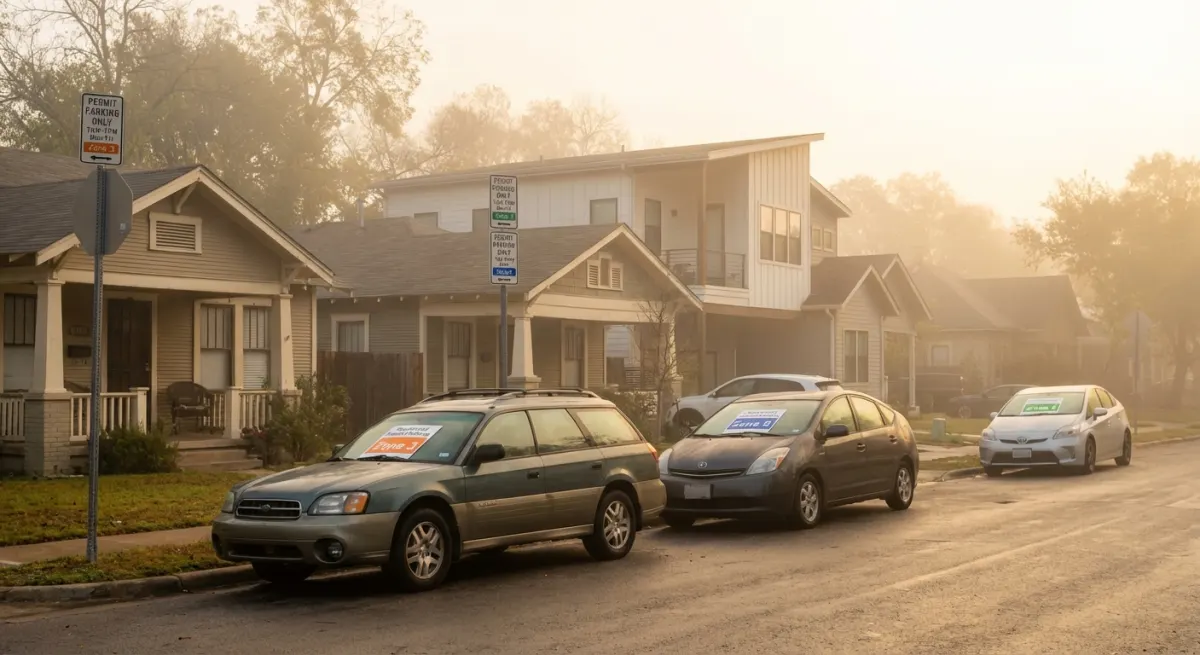
Austin’s major Residential Permit Parking (RPP) overhaul quietly took effect July 16, 2025—and most residents still don’t realize how much their neighborhood parking strategy just changed. This is the first true restructuring of the program in years, and the city’s rule refinements now impact permits, enforcement, zone timelines, visitor parking, and permit caps in ways Austin drivers can’t afford to ignore. You can see the full breakdown of the 2025 changes on the City’s Residential Permit Parking Program overview page.
What follows is the essential, plain‑English breakdown of what changed, why it matters, and the insider intel residents won’t find in the city’s policy memo.
Bookmark both the city’s Residential Permit Parking Program overview and the online Residential Parking Permit portal—those pages are updated far more frequently than printed mailers or street signage.
WHAT CHANGED IN THE NEW RPP RULES
• Tiered pricing now applies to all resident permits: $60 for the first, up to $90 for the fourth. Official pricing details and current fees are listed under Residential Permits on the city’s RPP pricing and permits info.
• Households may buy up to four resident permits and two visitor hangtags (except Mueller, which is capped at two total), as outlined in the 2025 RPP rule update details.
In Mueller, the “two total” cap includes both resident permits and visitor hangtags, so households there often need to lean more on paid day passes, carpools, or shared vehicles for regular guests.
• Hybrid Parking Zones now allow residents to park with permits while visitors must pay; eligible addresses in these hybrid blocks can confirm their free permit allowances using the city’s eligibility and interactive RPP map.
Hybrid rules can change mid‑block or mid‑street—always plug your exact address (or building name) into the eligibility map instead of assuming your whole street has the same permit and payment rules.
• Expiration dates are now split into two renewal calendars: July 31 for the UT-area orange zone, December 31 for all others; both renewal timelines appear on the main Residential Permit Parking Program overview.
• No grace period—citations begin the day your permit expires, a policy also reinforced in third‑party guides like the Austin street parking overview from SpotAngels.
There is no grace period once your RPP expires—parking officers can ticket you the very first day your permit lapses, even if you’ve never had a citation before. Set your own reminders; renewal notices aren’t guaranteed.
• Residents must update permits whenever vehicles change; because permits are now plate‑tied and largely digital, you’ll manage these updates through the city’s online Residential Parking Permit portal.
These updates stem from an extensive rule refinement process addressing fairness for renters, parking overflow near commercial corridors, and inconsistent access in crowded neighborhoods; the May 2025 draft process and community pushback are documented in coverage by Austin Monitor on the 2025 RPP rule refinements. For historical context on how the program evolved from its 1997 origins near busy entertainment districts, the city’s RPP Director’s Rules PDF traces how commercial corridor pressures shaped today’s overhaul, which also ties into the broader struggles described in our look at downtown Austin’s small business crisis and relief efforts.
The 2025 overhaul is one of the first times renters, students, and nightlife‑adjacent neighborhoods had major influence on RPP rules—so expect the strictest enforcement and fastest rule tweaks near campuses and busy commercial corridors.
WHAT RESIDENTS NEED TO DO NOW
• Check your zone color immediately to confirm your renewal deadline using the city’s RPP eligibility listing and interactive map.
• Reassess whether your household actually needs multiple permits, since costs escalate; the city’s parking services page lists current tiered pricing and visitor options.
• Confirm if your address qualifies for free Hybrid Zone permits through the same Residential Permit Parking map tool.
• Set renewal reminders—expired permits are enforced same‑day, and you’ll handle renewals in the online Residential Parking Permit portal.
• Keep documents ready: ID, proof of residency, lease/mortgage, and recent utility bill, all of which are listed under required materials in the official RPP program overview. For more ways to stack savings on transportation and parking around town, see our broader Austin mobility and parking hacks guide.
Create a shared renewal plan for your household—add calendar alerts a few weeks before your zone’s deadline, and keep a quick note of which plates are tied to which permits so roommates don’t accidentally move cars without updating the system.
INSIDER INTELLIGENCE AUSTINITES ARE MISSING
• Hybrid Zones are expanding faster than the city communicates. If you live near mixed‑use corridors in East Austin or South Lamar, check your block—some residents now qualify for two free resident permits, which you can verify via the RPP eligibility map and hybrid zone listings.
• Day passes at $5 each may be more cost‑efficient than visitor hangtags for households with occasional guests; current day‑pass pricing and purchase steps are on the city’s parking permits information page.
• Vehicle swaps are the top cause of unexpected RPP citations. The permit is tied to the plate, not the household, and you’ll need to update your vehicle information promptly through the digital Residential Parking Permit portal.
Any time you buy, sell, or regularly borrow a different car, update your RPP info the same day—the system is license‑plate based, so “having a permit at this address” won’t protect you from a ticket if the plate doesn’t match.
• UT-area residents should expect stricter July enforcement in 2026; the city is piloting enhanced compliance tech in the orange zone, which is also where you’ll see the July 31 renewal date highlighted on the main Residential Permit Parking Program overview.
• Streets petitioning for new RPP restrictions must show clear non-resident parking impacts; neighborhoods near new bars, breweries, and entertainment corridors are now considered higher priority, and you can start the process or review thresholds through the city’s “Submit Your Street for RPP” guidance. These petitions often track closely with emerging nightlife and growth corridors, echoing the same commercial‑pressure storylines shaping East Austin’s culture and access in our feature on Huston‑Tillotson and East Austin’s identity.
PRIMARY SOURCE LINKS
• City of Austin RPP Program Overview: https://www.austintexas.gov/department/residential-permit-parking
• RPP Rule Update Details (2025): https://www.austintexas.gov/department/transportation-and-public-works
• RPP Pricing & Permits Info: https://www.austintexas.gov/parking
• RPP Eligibility Listing & Interactive Map: https://www.austintexas.gov/department/residential-permit-parking
• Residential Parking Permit Portal: https://www.austintexas.gov/parking
• Historical Director’s Rules PDF: https://www.austintexas.gov/department/transportation-and-public-works
• Austin Monitor Reporting on 2025 RPP Rule Refinements: https://www.austinmonitor.com/
• PublicInput RPP Community Survey Archive: https://www.publicinput.com/
Austin’s 2025 RPP overhaul isn’t just a policy update—it’s a full shift in how neighborhoods manage curb access. Knowing your zone, tracking your renewal date, and understanding the new pricing structure will save residents real money and prevent avoidable tickets in the coming year, especially when paired with smarter city‑wide strategies like those in our Austin mobility and parking savings guide.
Austin’s New RPP Rules: your questions answered
- How much does a residential parking permit cost in Austin?
- Austin's resident vehicle permits are tiered: $60 for the first permit, $70 for the second, $80 for the third, and $90 for the fourth, plus 8.25% sales tax. Visitor hangtag permits cost $90 each, and single-day passes are $5. Households can buy up to 4 resident permits and 2 visitor hangtags (Mueller households are capped at 2 total).
- How do I apply for a residential parking permit in Austin?
- Apply online through the City of Austin's permit portal at parkatx.cmrpay.com, or in person at the Mobility Services Division, 1501 Toomey Road, Monday–Friday 8am–3pm. You can also reach the office at MobilityServices@AustinTexas.gov or 512-974-7857.
- Is there a grace period after an Austin RPP expires?
- No — there is no grace period. Parking enforcement can ticket a vehicle the very first day its permit lapses. Renewal deadlines are July 31 for the UT-area orange zone and December 31 for all other zones.
- How many parking permits can one Austin household get?
- Most households may purchase up to 4 resident vehicle permits and up to 2 visitor hangtag permits. Mueller is the exception — residences there are capped at 2 permits total, combining resident and visitor permits.
Related Austin Data
Share this article