
Austin Homeowner Guide
Aging in Place in Austin: The Home Modifications That Keep Seniors Safe (and What They Cost)
Most people, asked where they want to grow old, give the same answer: right here, in my own home. The good news is that staying put rarely takes a dramatic renovation. It usually takes a short list of smart, well-placed changes — and knowing which ones to do first.
Explore repair assistance before requesting quotes
Public and nonprofit programs may help eligible homeowners with safety or accessibility work. The first useful step is checking the program’s eligibility and intake process, not assuming every project qualifies.
3 linked sources · CheckedStart with the City homeowner interest form
Austin’s home-repair page directs homeowners to an interest form and explains that staff determine next steps. Assistance depends on eligibility and the kind of repair needed.[1]
Meals on Wheels also repairs homes
Meals on Wheels Central Texas operates a home-repair program for eligible homeowners, with work focused on health and safety. Its published criteria and intake route determine whether it fits your situation.[2]
Habitat focuses on critical repairs
Austin Habitat’s home-repair program describes health, safety and accessibility repairs rather than cosmetic remodeling. Review its eligibility criteria before treating it as a project funding source.[3]
Before you go
- Separate household applications from funding notices
- The City page includes information for nonprofit repair providers as well as homeowners. A contractor funding deadline is not automatically a homeowner application deadline.[1]
- Ask about the scope before committing
- Habitat’s program is for qualifying critical repairs. Use the program’s application information to establish whether the home, household and requested work meet its criteria.[3]
A few things to know
Does submitting the City interest form guarantee repairs?
No. The City describes an intake process followed by staff review and next steps. Eligibility and the repair request still need to be assessed.[1]
Are these programs intended for cosmetic renovations?
Austin Habitat identifies its program as critical home repair addressing health, safety and accessibility needs. Cosmetic remodeling is outside that stated purpose.[3]
Sources & research notes
Local context is based on the sources below. Confirm current access, schedules, and reservations with the operator. Civic figures elsewhere on this page retain their own reporting periods.
- Home Repair Programs | Austin Housing | AustinTexas.govCity of Austin · Checked 2026-09-05
- Home Repair | Meals on Wheels Central TexasMeals on Wheels Central Texas · Checked 2026-09-05
- Home Repair - Austin Habitat for HumanityAustin Habitat for Humanity · Checked 2026-09-05
The goal: stay home, safely
“Aging in place” is the industry term for what most families simply call staying home. The obstacle is rarely the house itself — it’s a few specific hazards. An assessment should consider the person’s mobility, the routes they use each day, lighting, entrances and bathroom access. Home modifications can address particular barriers, but the right priorities depend on the person and the building.
The trap to avoid is waiting for a crisis. Most accessibility projects get started the week after a fall or a hospital discharge, under pressure, at full price. A little planning ahead turns the same work into a calm, staged upgrade.
Start with a safety walk-through
Before buying anything, walk the house with fresh eyes — ideally with a professional. The cheapest wins come first: better lighting, removing trip hazards and loose rugs, lever door handles, and properly anchored grab bars where they’re actually needed. Live Oak Home Access publishes a free aging-in-place home safety checklist you can use to do a first pass yourself, and they offer a whole-home accessibility assessment that prioritizes the full list by risk and budget.
The modifications that matter most
Nearly every aging-in-place plan is some combination of three things: safer bathing, easier entry, and getting between levels.
In the bathroom
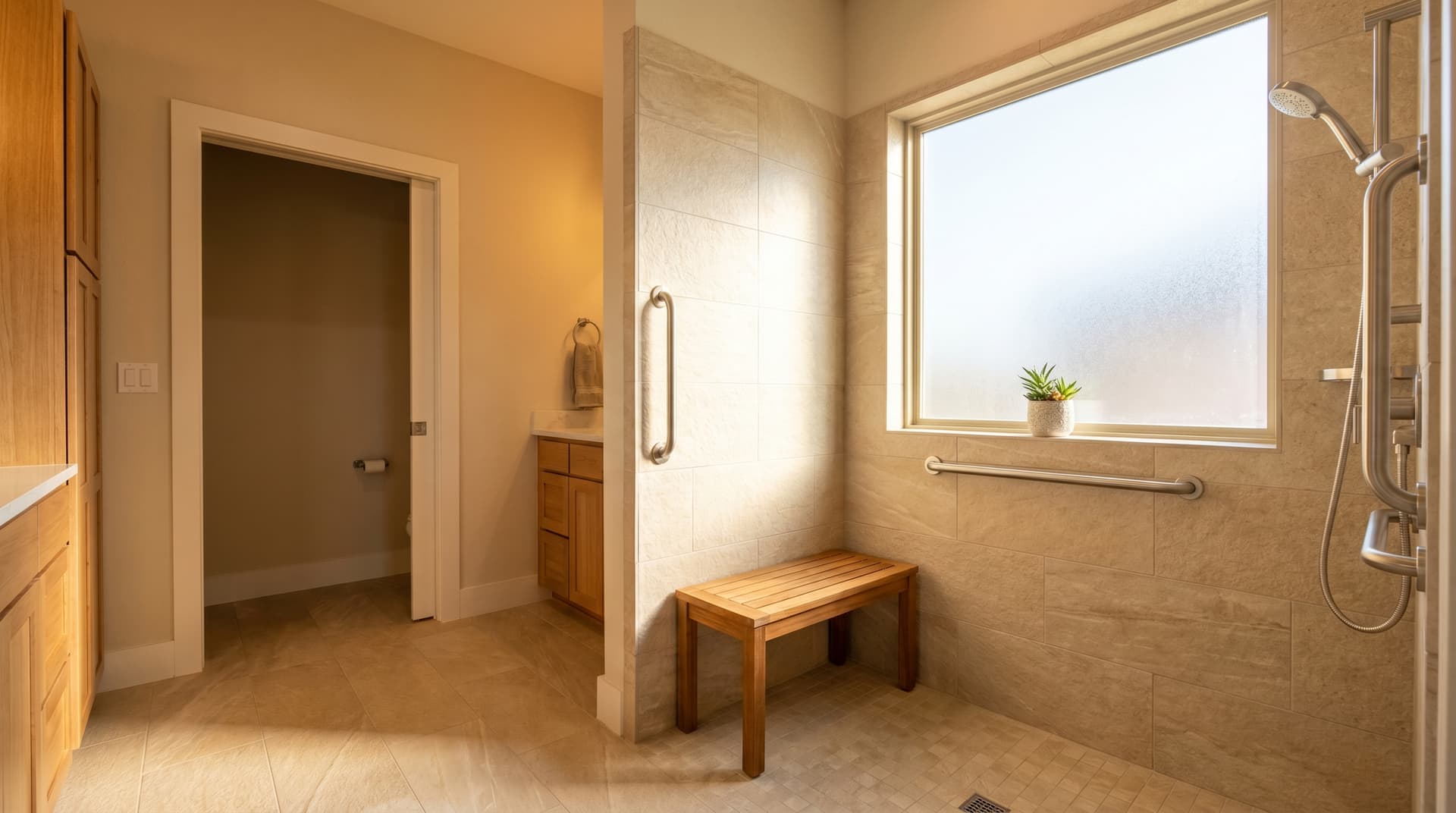
This is where the money does the most good. A curbless or walk-in shower removes the single biggest fall hazard in the house — stepping over a tub wall on a wet floor. Pair it with sturdy, professionally installed grab bars (not the suction-cup kind), a comfort-height toilet, and a hand-held shower, and the highest-risk room becomes the safest. Where a soak is non-negotiable, a walk-in tub is an option, though a curbless shower usually delivers more safety per dollar.
Getting in and around
A wheelchair ramp or a zero-step entry removes the threshold that keeps walkers and chairs out, and widening a doorway or two makes the rest of the house reachable. These are the changes that decide whether someone can move through their whole home or gets boxed into a couple of rooms.
Between floors
For two-story homes, a stair lift is the workhorse solution; for wheelchair users or a longer-term plan, a platform lift or a residential elevator keeps the upstairs in play. You can see the full menu of options on Live Oak’s services overview.
What it costs in Central Texas
Costs vary with the size of the job, the finishes, and how much plumbing or structural work is involved, but local ranges are predictable enough to budget around. These figures come from Live Oak Home Access’s Central Texas cost guide:
| Modification | Typical Central Texas cost |
|---|---|
| Tub-to-shower conversion | $3,500 – $7,500+ |
| Curbless / zero-threshold shower | $5,500 – $15,000+ |
| Grab bars (single → full package) | $150 – $2,500 |
| Walk-in tub | $5,000 – $18,000+ |
| Wheelchair ramp | $1,200 – $10,000+ |
| Stair lift (straight → curved) | $3,000 – $18,000+ |
| Doorway widening | $800 – $10,000+ |
| Residential elevator / platform lift | $3,500 – $60,000+ |
| Full accessible bathroom remodel | $12,000 – $55,000+ |
If you only do one thing, make it the bathroom: a curbless shower plus grab bars is consistently the best safety-per-dollar investment in the house.
How Texans pay for it
Sticker shock is real, but very few families pay full price out of pocket once they know where to look. Live Oak’s Texas home-modification funding guide walks through the details; the main avenues are:
- VA grants (HISA, SAH/SHA). For veterans, the Home Improvements and Structural Alterations grant and the larger Specially Adapted Housing / Special Home Adaptation grants can fund ramps, roll-in showers, grab bars, and doorway widening when documented as medically necessary.
- Texas Medicaid STAR+PLUS HCBS waiver. Its Minor Home Modifications benefit covers ramps, grab bars, and accessible bathrooms for those who qualify financially and functionally (interest lists can apply).
- Medicare reality check. Original Medicare won’t pay for most modifications, but it does cover durable medical equipment, and some Medicare Advantage plans add limited home-safety benefits.
- Area Agencies on Aging. CAPCOG (Austin metro and Hill Country) and AACOG offer free benefits counseling and referrals to local programs.
- Nonprofits & tax breaks. Habitat for Humanity affiliates and faith-based volunteer groups help in some cases, and modifications made for documented medical reasons may be deductible medical expenses (see IRS Publication 502 and your tax advisor).
Helpful starting points: the Eldercare Locator (1-800-677-1116) and 2-1-1 Texas (dial 211).
The bottom line
Aging in place isn’t one big decision — it’s a series of small, smart ones, made a little before you need them. Start with a safety walk-through, fix the bathroom first, and line up funding early. Done right, the home you love stays the home you live in.
Aging in place in Austin: FAQ
What does "aging in place" mean?
Aging in place means staying in your own home safely and comfortably as you get older, rather than moving to assisted living or a care facility. For most homes it comes down to a handful of targeted modifications — safer bathing, no-step entry, better lighting and support — that remove the hazards that tend to force a move.
What home modifications help seniors stay at home?
Common accessibility changes are in the bathroom (a curbless or walk-in shower, grab bars, a comfort-height toilet), at entrances (a zero-step entry or wheelchair ramp), and between floors (a stair lift or platform lift). Wider doorways, lever handles, and improved lighting round out a typical aging-in-place plan.
How much does a walk-in or curbless shower cost in Central Texas?
A basic tub-to-shower conversion runs roughly $3,500–$7,500, a curbless zero-threshold shower about $5,500–$15,000, and a full roll-in shower with bench and blocking $6,500–$18,000 or more, depending on size, tile, and plumbing. The appropriate scope depends on the person, the home and the assessment.
Does Medicare pay for home modifications?
Generally no. Original Medicare does not cover grab bars, ramps, walk-in tubs, or stair lifts, though it does cover durable medical equipment like wheelchairs when medically necessary. Some Medicare Advantage plans add limited home-safety benefits, and Texas Medicaid’s STAR+PLUS HCBS waiver and VA grants (HISA, SAH/SHA) can cover qualifying modifications.
What is the most important safety change to make first?
Start with an assessment of the person’s needs and the whole home, including entrances, lighting, walking routes and the bathroom. That review should determine the sequence of changes.
Who installs accessibility modifications in the Austin area?
Live Oak Home Access is a Central Texas specialist focused entirely on aging-in-place and accessibility remodeling — walk-in showers, ramps, stair lifts, grab bars and full accessible bathrooms — serving Austin, Dripping Springs, Georgetown, Sun City, Lakeway, Lake Travis and surrounding communities, with a free in-home assessment.