
Austin Homeowner Guide
What Austin’s Clay Soil Does to Your Foundation (and How to Check Your Risk)
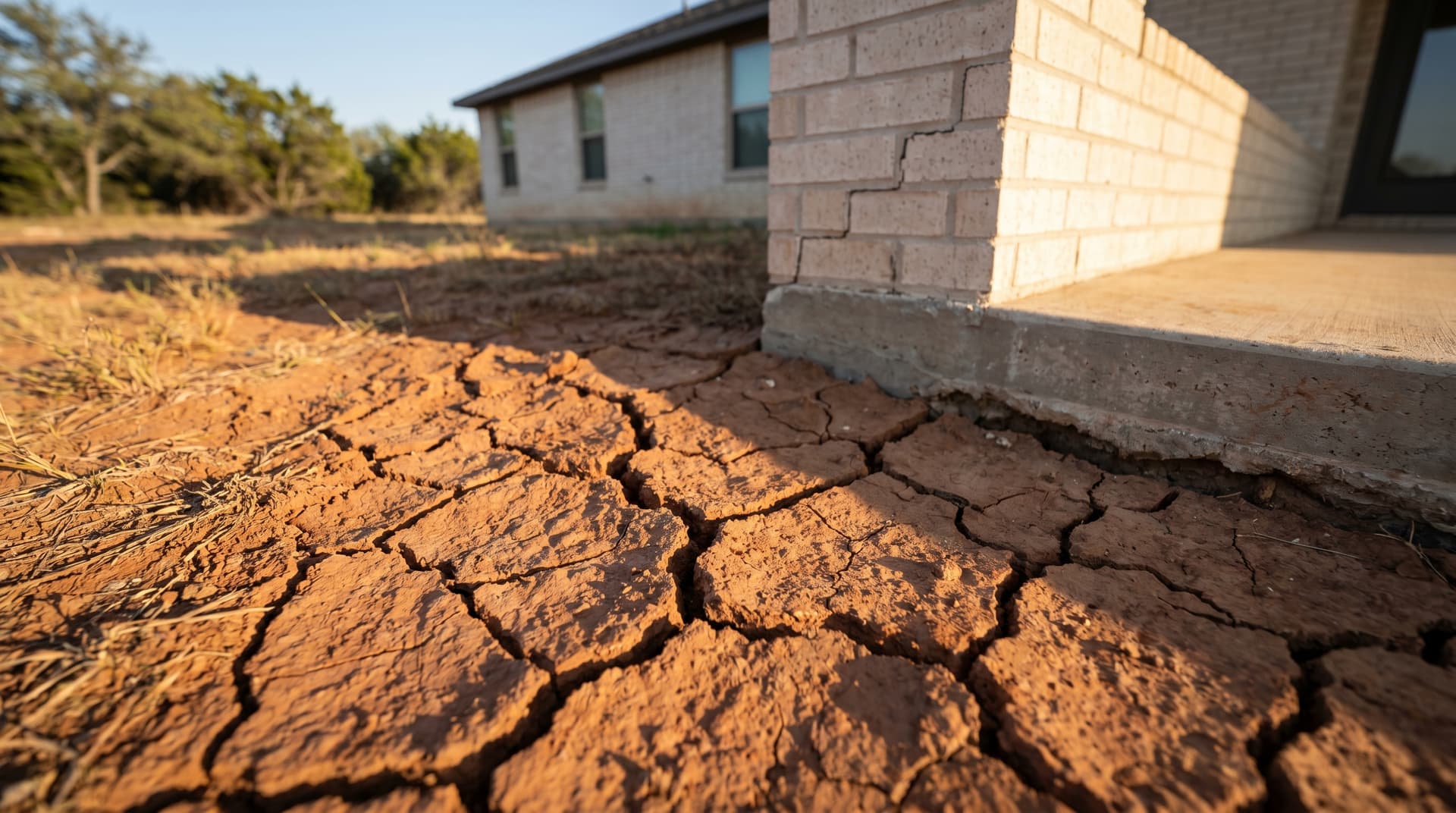
Two nearly identical houses can sit a few miles apart in Austin and meet completely different fates. One stays square for decades. The other develops stair-step cracks in the brick, doors that won’t latch, and a repair bill in the five figures. The difference usually isn’t construction quality — it’s the dirt underneath.
Look up the soil before interpreting a crack
An address-level soil lookup gives useful planning context. A mapped soil unit and a building-suitability rating are still different from an on-site assessment of an individual foundation.
3 linked sources · CheckedStart with an area of interest
USDA’s Web Soil Survey lets you define an area of interest, view mapped soils and explore interpretations. Its getting-started guide explains the steps and the resulting soil reports.[1][2]
Read the map unit and its limitations
The Soil Data Explorer provides soil properties and suitability interpretations. Read the selected rating and its explanation instead of reducing the result to a single soil name.[2]
Use soil limitations as planning context
NRCS identifies soil properties and limitations that affect uses including construction. These interpretations support planning; they do not establish the cause of a specific crack in a building.[3][1]
Before you go
- Save the report for the property discussion
- Web Soil Survey can assemble a custom soil report for the chosen area. Keeping that report makes the mapped information available when discussing a property with a qualified professional.[2]
- Keep the map and the house assessment separate
- NRCS describes soil survey information as a planning and land-use resource. Use that context alongside site-specific assessment rather than treating a map as an inspection of the structure.[1]
A few things to know
Can I look up soils for an Austin address?
Yes. Web Soil Survey supports locating a place and drawing an area of interest. From there, use the Soil Map and Soil Data Explorer described in the USDA guide.[2]
Does a soil map diagnose foundation damage?
No. A soil survey describes mapped soil properties and interpretations. It does not inspect the individual building or establish why a particular foundation has moved.[1]
Sources & research notes
Local context is based on the sources below. Confirm current access, schedules, and reservations with the operator. Civic figures elsewhere on this page retain their own reporting periods.
- Web Soil Survey | Natural Resources Conservation ServiceUSDA Natural Resources Conservation Service · Checked 2026-09-05
- Getting Started With Web Soil Survey | Natural Resources Conservation ServiceUSDA Natural Resources Conservation Service · Checked 2026-09-05
- Soil Facts | Natural Resources Conservation ServiceUSDA Natural Resources Conservation Service · Checked 2026-09-05
Why Austin sits on some of the trickiest foundation soil in the country
Much of Austin and the communities east of it sit on the Blackland Prairie — a band of dark, fertile, notoriously expansive clay. The state soil of Texas, Houston Black clay, lives right here. Geologists call these soils Vertisols, and the trait that makes them great for farming is the same one that wrecks foundations: they are loaded with smectite clay minerals that drink up water and swell, then give it back and shrink.
The result is a soil that doesn’t stay put. Across a wet-to-dry cycle, expansive clay can move several inches vertically. A house is heavy and rigid; the ground beneath it is neither. When one part of the soil swells while another dries out and contracts, the foundation has to absorb that mismatch — and concrete and drywall are not built to flex.
The I-35 divide: one highway, two very different fates
Here is the single most useful thing to understand about foundations in Austin: risk roughly splits along the Balcones Fault, which more or less follows I-35. As TrueLevel’s engineers put it, “two homes a few miles apart can have completely different foundation fates.”
- East of I-35 — higher risk. This is expansive Blackland Prairie clay country: Taylor, Manor, Pflugerville, Hutto, Del Valle and much of East Austin. Foundation movement here is common, not exotic.
- West of I-35 — generally more stable. The Hill Country sits on the Edwards Plateau’s limestone. It is rockier and far less prone to shrink-swell, though shallow bedrock, cut-and-fill lots and karst features create their own headaches.
Because the geology changes so quickly, a citywide rule of thumb isn’t enough — what matters is the dirt under your specific lot. TrueLevel publishes a clear primer on Central Texas soil and geology if you want the deeper background on why the Balcones Escarpment matters so much.
What clay actually does to a slab (and to pier-and-beam)
Most Austin homes built since the 1970s sit on a slab-on-grade foundation — a single poured pad. When expansive clay swells in the center or dries at the edges, the slab is forced to bend; that differential movement telegraphs upward as cracked tile, separated drywall, and doors that bind. Older homes on pier-and-beam can shift and sag too, though they’re usually easier (and cheaper) to re-level.
Texas weather makes it worse. The brutal droughts of 2011 and 2022–2023 baked the clay until it pulled away from foundations statewide; the next heavy rains swelled it back. Thirsty mature trees — live oaks, elms — pull moisture out of the soil right next to the house, and an undetected plumbing leak under a slab can soften and move the ground from below. None of these act alone; they stack.
Warning signs worth watching for
You don’t need to be an engineer to spot trouble early. Walk your house once a season and look for:
- Stair-step cracks in exterior brick or mortar joints
- Diagonal cracks running from the corners of doors and windows
- Doors and windows that suddenly stick, drag, or won’t latch
- Gaps opening between exterior trim, brick, and the frame
- Sloping, sagging, or bouncy floors
- Cracks in interior drywall, ceilings, or above doorways
- Gaps appearing between countertops, cabinets, and the wall
One hairline crack is usually nothing — houses settle. The signal to take seriously is a pattern that grows across a wet-then-dry season. If you’re seeing several of these at once, it’s worth getting ahead of it.
How to check your home’s risk — free, in about two minutes
Before you pay anyone for an inspection, start with the soil. The fastest way we’ve found is TrueLevel’s free Foundation Risk Checker: you type in your Austin address and it maps your lot to USGS bedrock formations and USDA soil-survey data, then returns a shrink-swell risk rating from Low all the way up to Very High. It’s instant, free, and genuinely useful as a first screen — it tells you whether your dirt is the kind that demands vigilance or the kind you can mostly stop worrying about.
What foundation repair actually costs in Austin
If your risk is real, the next question is money. The honest answer for Central Texas: most slab repairs land between $4,000 and $12,000, with a typical job around $8,000. Severe corrections can run past $25,000. As TrueLevel’s cost breakdown puts it bluntly, “piers are the price” — the number and type of piers drives the estimate more than anything else.
| Repair | Typical Austin cost |
|---|---|
| Hairline / cosmetic crack sealing | $500 – $1,500 |
| Pressed concrete piling (per pier) | $300 – $800 · 8–20 piers typical |
| Steel piers (per pier) | $1,200 – $2,500 |
| Typical complete slab repair | $4,000 – $12,000 |
| Pier & beam re-leveling | $5,000 – $15,000 |
| Major / severe correction | $15,000 – $30,000 |
A few things keep those numbers honest. An independent engineer’s report usually costs only a few hundred dollars and is worth it for anything beyond cosmetic cracks. And much of the real fix is drainage — grading, gutters, downspout extensions, French drains — because controlling water around the slab treats the cause, not just the symptom. You can sanity-check a quote against TrueLevel’s Austin foundation repair cost guide or run the numbers yourself with their cost estimator.
Buying or selling a house with foundation history
In Austin, “this home had foundation work” is common enough that treating it as an automatic deal-breaker will knock a lot of good houses off your list. A documented repair with a transferable warranty and a clean engineer’s letter is often a non-issue — sometimes it’s a positive, because the worst of the movement has already been addressed. The mistake is reacting emotionally in either direction.
If you’re house-hunting, fold soil risk into how you research Austin neighborhoods in the first place, then get an independent structural engineer’s evaluation on any specific home before you remove your option period. TrueLevel has a practical walkthrough on buying a house with foundation issues that’s worth reading before you write an offer.
How to protect the foundation you have
The cheapest foundation repair is the one you prevent. In Central Texas, prevention is mostly about keeping soil moisture steady:
- Water your foundation in droughts. Soaker or drip hoses 12–18 inches out from the slab keep the clay from shrinking away from the house.
- Move water away. Maintain positive grading, keep gutters clear, and extend downspouts so rain doesn’t pool against the slab.
- Mind the trees. Large, thirsty trees near the house can pull serious moisture from the soil; root barriers help.
- Fix plumbing leaks fast. A slow under-slab leak quietly remakes the ground your house stands on.
The bottom line
Austin’s clay isn’t a reason to panic — it’s a reason to pay attention. Know which side of the Balcones Fault you’re on, watch for the patterns that matter, keep the soil around your slab evenly moist, and check your address before you buy. Two minutes on a foundation risk checker can save you a five-figure surprise later.
Austin clay soil & foundations: FAQ
What does clay soil do to a house foundation?
Austin sits on expansive clay that absorbs water and swells in wet weather, then shrinks and pulls away from the foundation in droughts. That repeated up-and-down movement — sometimes several inches across a single year — pushes unevenly on a slab or pier-and-beam foundation, which shows up as cracks, sticking doors, and sloping floors.
Which parts of Austin have the worst foundation soil?
Generally the areas east of I-35, which roughly traces the Balcones Fault. East of that line you find expansive Blackland Prairie clay (Vertisols) in places like Taylor, Manor, Pflugerville, Hutto, Del Valle and much of East Austin, where foundation movement is common. West of I-35, the Hill Country sits on Edwards limestone, which is rockier and generally more stable for shrink-swell — though it has its own issues. Risk can change within a few miles, which is why an address-level check matters.
How much does foundation repair cost in Austin?
Most Austin slab repairs run between $4,000 and $12,000, with a typical job around $8,000. Cosmetic crack sealing can be $500–$1,500, while major corrections — especially on pier-and-beam homes or severe movement — can exceed $25,000. The pier count and pier type usually drive the price more than anything else.
What are the warning signs of foundation problems?
The most common signs are stair-step cracks in exterior brick or mortar, diagonal cracks running from the corners of doors and windows, doors and windows that suddenly stick, gaps opening at exterior trim, sloping or bouncy floors, and cracks in drywall or ceilings. A single hairline crack is usually nothing; a pattern that grows over a season is the red flag.
How can I check my home's foundation risk for free?
TrueLevel's free Foundation Risk Checker lets you type in your Austin address and instantly see a shrink-swell risk rating based on USGS bedrock and USDA soil-survey data. It is instant, free, and a smart first step before paying for an on-site inspection.
Should I buy a house in Austin that has had foundation repair?
Often, yes. A documented repair with a transferable warranty and an engineer’s letter can make a previously-repaired home a perfectly sound purchase. The mistake is reacting emotionally either way — get an independent structural engineer’s evaluation, understand what was done, and use it in negotiation rather than walking automatically.