Listen to this story 9:39
Jump to a section
Read aloud by an AI voice (ElevenLabs) from the story on this page, which is the full transcript. Tables and maps are summarized in the audio.
Quick answer: The Cox Springs School is a 728-square-foot, one-room wooden schoolhouse on Old Burnet Road in Jonestown, northwest of Austin, Texas, on the north shore of Lake Travis. It was cut in half and trucked uphill for $100 when Lake Travis rose. This week the state registered a $175,000 restoration of it. According to ATX Things' read of the state record, the filing covers work that started in 2021 and, by the Society's own updates, is well along. It is not the start of a new project.
Illustration: AI-generated for this article. It is not a photograph of the actual building.
What did the state actually register on Oct. 23?
The Texas Department of Licensing and Regulation (TDLR) lists project TABS2027004298, "Cox Springs School Restoration Society," as registered on Oct. 23, 2026. We read the record on Oct. 24. It carries these details:
| Field | What the record says |
|---|---|
| Facility | Cox Springs School, 18725 Old Burnet Rd, Jonestown |
| Type of work | Renovation/alteration, 728 sq ft |
| Estimated cost | $175,000 |
| Start date | June 12, 2021 |
| Completion date | Nov. 16, 2026 |
| Owner | Hollows Property Owners Association Inc |
| Design firm | Hutson Gallagher, Inc. (Austin) |
| Status | Project Registered |
The scope line reads: "Restore historic one-room schoolhouse: structural stabilization; exterior envelope (siding, doors, porches, roof decking, chimney, replica metal skirting); interior floors, walls, ceiling, replica windows; remove non-historic additions."
Two things in the record are easy to misread. The start date is 2021, so this is not a new project. And the form's funding line carries the state's standard wording, "public funds, public land, or is a Federally funded roadway project," while a separate question says private funds come from the tenant. The Society describes itself as volunteer and donor funded. We do not know what triggered the public-funds wording, and we have not asked.
We have not spoken to the Society, so we do not know why the filing landed in October 2026. A registration with a 2021 start date is a hint that this is catch-up paperwork on a phased, donation-driven job. That is our reading, not theirs.
Why was a school moved in two halves?
The short version: Lake Travis. The Society's history page says the school began around 1885 for farm and ranch children in the Anderson Bend area along the Colorado River. It moved near Cox Hollow Springs around 1900. In 1908 the district bought five acres from the Simpson family and built a new building. That one burned in December 1927 from a faulty stove flue. The Society's account says there was one bucket of water on hand.
The building that stands today went up in 1928. Then the river was dammed. Mansfield Dam construction began in 1938, and by fall 1940 the backwater was covering the river-bottom farms. Many families sold to the Lower Colorado River Authority and left. The school had lost most of its students, and the Society says the building was about to be sold for barnwood.
Two landowners who stayed on higher ground, the Carlton and Pearson families, had the building sawed in half, loaded onto flatbed trucks and reassembled on Old Burnet Road. The Society puts the cost at $100.
"Schoolhouse about as bad as can be – needs a new one to take its place. — Travis County School Annual, 1906, as quoted on the Cox Springs School website
One date does not agree. The Society and Preservation Texas say the move was in 1941. A historical marker that once stood at the site, now removed, said 1940. We use 1941 for the move and note the difference rather than pick silently.
What was school like out there?
The details come from the Society's history page, which draws on community records, and they are the best part:
- The first day at the new site was in mid-October 1941, paid for by local tax money alone. The teacher earned about $80 a month for seven months.
- When World War II rationing hit, ads for a teacher ran in the Austin papers and nobody would drive that far on rationed tires and gasoline. A summer term in 1943 ran May through August.
- In May 1944 voters raised the local school tax from 25 cents to 50 cents per $100 of valuation. It passed six to three.
- In 1946 the school started a lunchroom, cooking on a wood-burning range for about twenty lunches a day. The Carlton family supplied about four gallons of milk a week.
- The school was not accredited, yet three students who went through 11th grade there were allowed to graduate from high schools in Marble Falls, Round Rock and Austin without extra training.
The last students moved to Lago Vista in fall 1959 (the removed marker said 1960). The building then housed the Cox Springs Church of Christ until 1968.
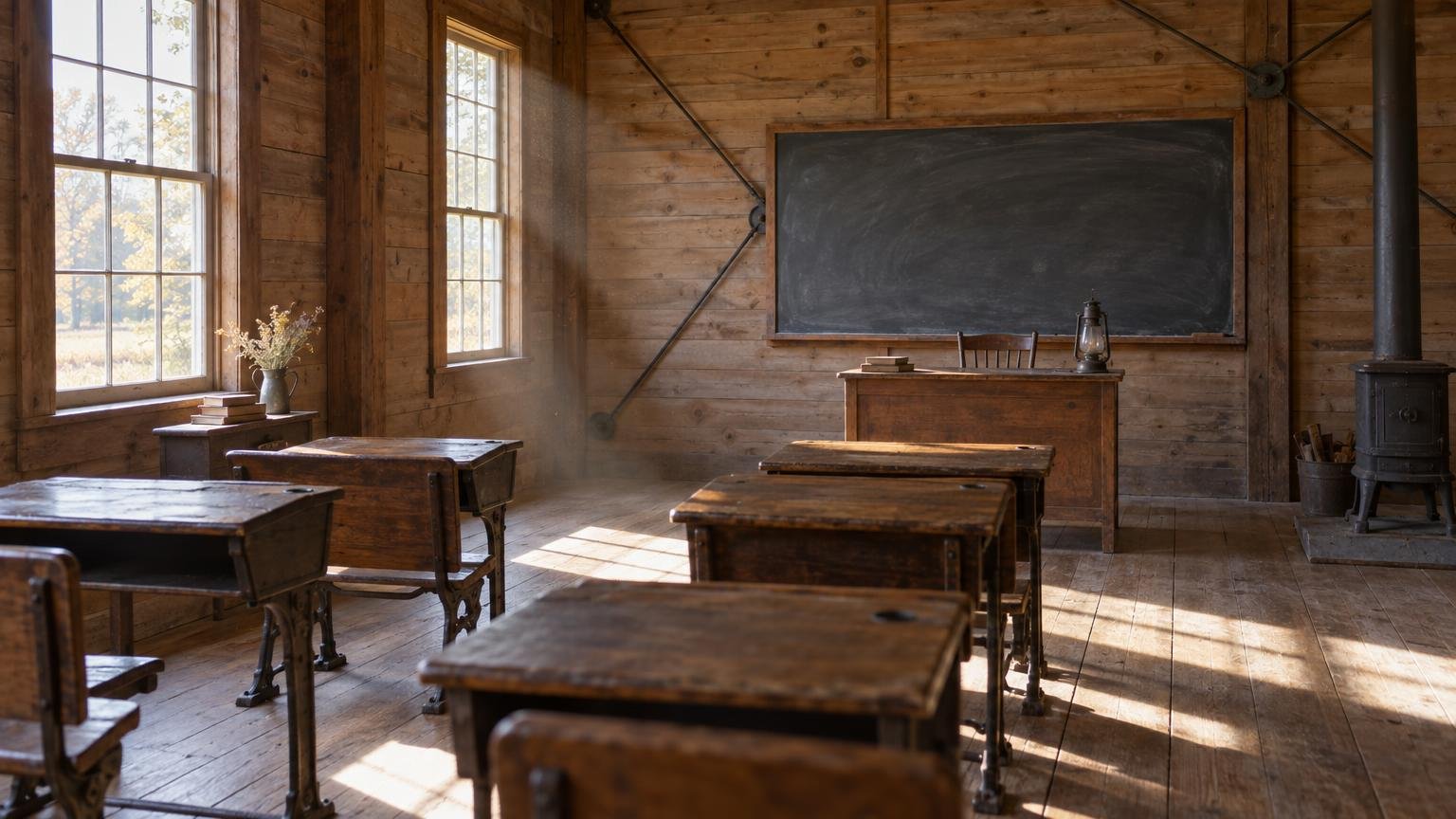
Illustration: AI-generated, based on descriptions of the restoration. Not a photograph of the actual interior.
How bad was it, and what has been fixed?
The Society's history page says that before stabilization work in July 2021 the building leaned with the wind and was held up mostly by its stone fireplace. Preservation Texas, which gave the project its 2025 Historic Restoration Award, describes three phases:
- Phase I: level the building, replace the failing cedar piers with concrete, add new joists.
- Phase II: rebuild the damaged part of the chimney with salvaged brick, repair the framing, reinstall the documented trim and chalkboard, and reinforce the failed north wall with exposed tie-rod framing that lets visitors see the original construction. Siding and battens were replaced only where needed, milled to the original profile, and the metal skirting was reproduced from fragments found on site.
- Phase III: document and replicate the eleven windows, which were too deteriorated to save.
The Society adds that in early 2025 it replaced all 11 windows, added air conditioning and built sidewalk access, so the room can serve as a community meeting place and small museum. Preservation Texas also says the school is listed on the National Register of Historic Places. We attribute that to Preservation Texas and have not checked the register ourselves.
Can you visit, and how do you help?
We could not confirm public hours. The building sits in The Hollows, a residential community, and its owner on the state record is the Hollows Property Owners Association. Do not assume you can wander up.
No public visiting hours were listed on the Society's pages we read. Contact the Society through its website before you drive out, and do not assume the grounds are open.
If you want to help, the Society's donate page lists three routes: its GoFundMe, a mailed check to the Society's Lago Vista P.O. box, or donated goods and volunteer labor. Per that page, each $500 donation is honored with a commemorative brick on a donor wall at the site. An older Society page set a $75,000 fundraising goal; the state filing lists $175,000. We do not know what each figure includes.
Want more Hill Country history near the lake? Our things to do in Austin page covers what is open now, and the October Austin Development Report shows how we track state construction registrations like this one.
FAQ
Where is the Cox Springs School?
At 18725 Old Burnet Road in Jonestown, Travis County, inside The Hollows community, just across the city line from Lago Vista on the north shore of Lake Travis.
How old is it?
The school dates to about 1885. The building standing now was completed in 1928, after a fire destroyed the previous one in December 1927, according to the Cox Springs School Restoration Society.
Why was it moved?
Lake Travis. Mansfield Dam's backwater flooded the Cox Springs area in 1940. The building was cut in half and moved to its present site, in 1941 per the Society and Preservation Texas (1940 per a removed marker).
What does the $175,000 state filing mean?
It is a Texas Department of Licensing and Regulation registration for the schoolhouse restoration, listing a 2021 start, a Nov. 16, 2026 completion date and a $175,000 estimate. It is a registration, not an approval or a grant.
Is it open to the public?
We could not confirm public hours. Contact the Society through coxspringsschool.com first.
Sources: TDLR project TABS2027004298, read Oct. 24, 2026 · Cox Springs School history and restoration updates · Preservation Texas, 2025 Historic Restoration Award · Historical Marker Database entry (marker removed). Google Places was not available for this edition, so no hours or drive times are quoted. This desk publishes twice a day on what is open, happening and worth the drive. Follow @austintexasthings.
Related Austin Data
More Austin Guides
Share this article