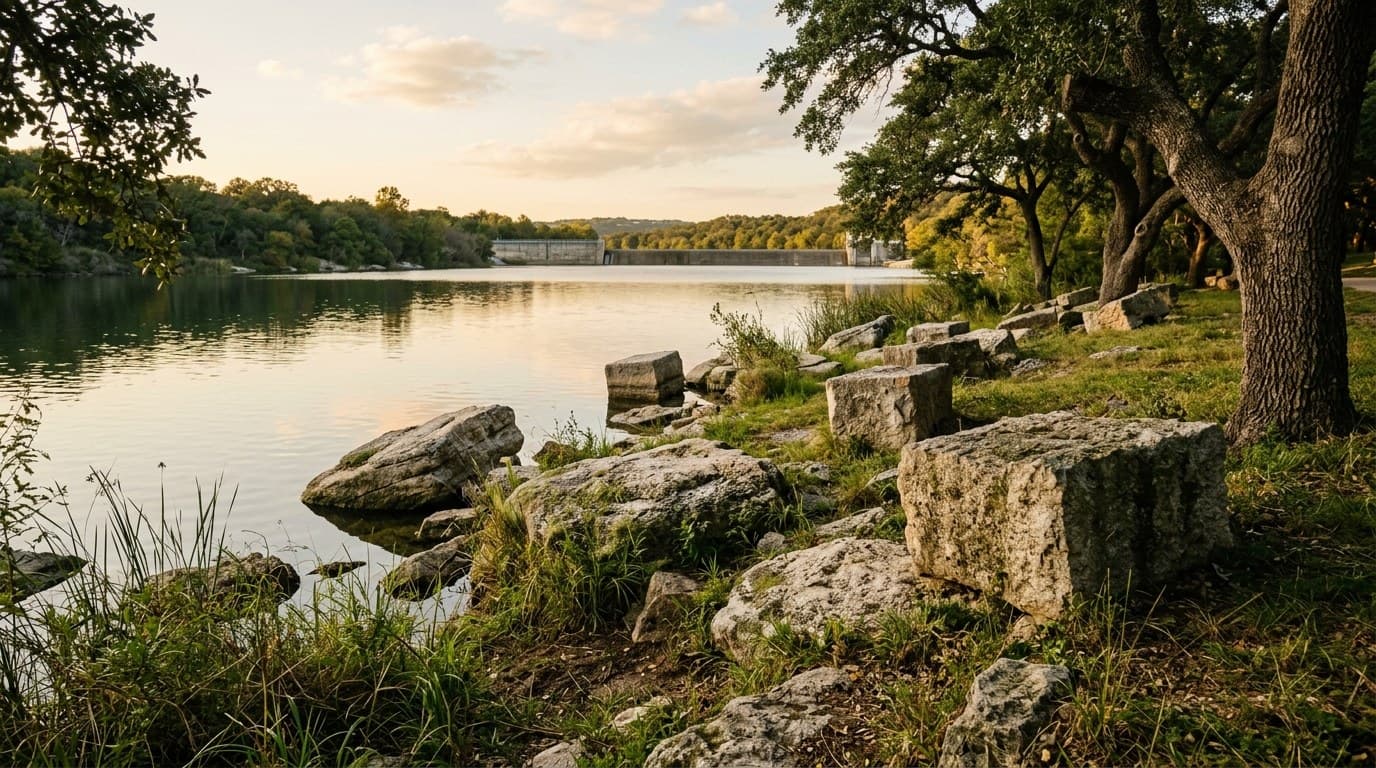
Quick answer: The granite boulders scattered around the parking lot at Red Bud Isle in Austin, Texas — one of the city's most popular off-leash dog parks — are wreckage from the Great Granite Dam, which collapsed on April 7, 1900, killing eight people instantly in its powerhouse and contributing to a flood that killed at least 50 people and destroyed roughly 100 homes across the city. According to ATX Things analysis of Austin History Center records, the island itself didn't exist before that day — it formed when the dam broke and the reservoir behind it, Lake McDonald, drained out.
What Actually Happened on April 7, 1900
Austin voted itself into debt in 1890 to build the dam, betting that cheap hydroelectric power would turn the sleepy state capital into "the Lowell of the South" — a cotton-mill boomtown to rival the industrial Northeast. The Great Granite Dam that resulted was enormous for its time: 60 feet high, nearly 1,200 feet across the Colorado River, built from Texas red granite blocks quarried and set by hand between 1890 and 1893. It was one of the largest dams on Earth when it was finished.
It never worked the way boosters promised. The river's flow was too unpredictable to run a bank of cotton mills, and the dam mostly ended up powering streetlights and the city's new electric streetcars instead. Then, on the night of April 6, 1900, storms upriver sent floodwater cascading over the dam's crest — witnesses said it looked like Niagara Falls. Crowds gathered the next morning to watch. At 11:20 a.m., according to the Austin Daily Statesman's own reporting from that week, a 300-foot section near the east end gave way with a crack "like a gunshot" and slid 60 feet downstream in seconds.
The wall of water hit the powerhouse first, flooding it instantly and drowning five employees and three young boys who'd been inside — eight deaths confirmed in the engineering reports filed after the failure. The surge that followed toward downtown Austin killed at least 50 people total and destroyed close to 100 homes, per Austin History Center records — Austin's deadliest single disaster.
Why Did the Dam Fail?
The short answer: it was built in the wrong place, and everyone who understood engineering knew it at the time. The dam sat directly on the Balcones Fault Zone, where the rock on the river's east bank was so loose it could be shoveled up by hand, letting water seep under the foundation for years before the collapse. Joseph Frizell, the dam's original engineer, quit during construction after Mayor John McDonald overruled his design decisions and let the contractor cut corners on materials — Frizell reportedly said a responsible engineer had no choice but to "abandon the work as he would abandon fire and pestilence." Several more engineers walked off the project after him. When the dam finally broke, historians studying the failure have generally concluded it was less a freak accident than a structure that had been failing slowly for years.
What Happened to the Dam Site Afterward?
Lake McDonald, the reservoir the dam had created, drained out within minutes of the collapse and never came back — the empty lakebed and the chunks of broken dam left behind eventually became Red Bud Isle. The city tried rebuilding the dam twice; a repair effort stalled in a contractor dispute in 1912, and a second flood in 1915 wrecked that attempt too. For four decades the ruins sat in the river as what one local writer called "a tombstone." The Lower Colorado River Authority finally rebuilt the site with federal money in 1940, folding the surviving 1893 and 1912 granite into the structure now known as Tom Miller Dam — the dam that impounds today's Lake Austin, just upstream of the island.
There's a second, quieter legacy: losing city-owned power for months after 1900 made Austin residents so wary of relying on a private utility again that the city bought out its old steam-powered electric company rather than risk it. That decision is the direct ancestor of today's Austin Energy — the same utility that, five years after the flood, strung up the 17 moonlight towers still standing across Central Austin using power generated at this same site.
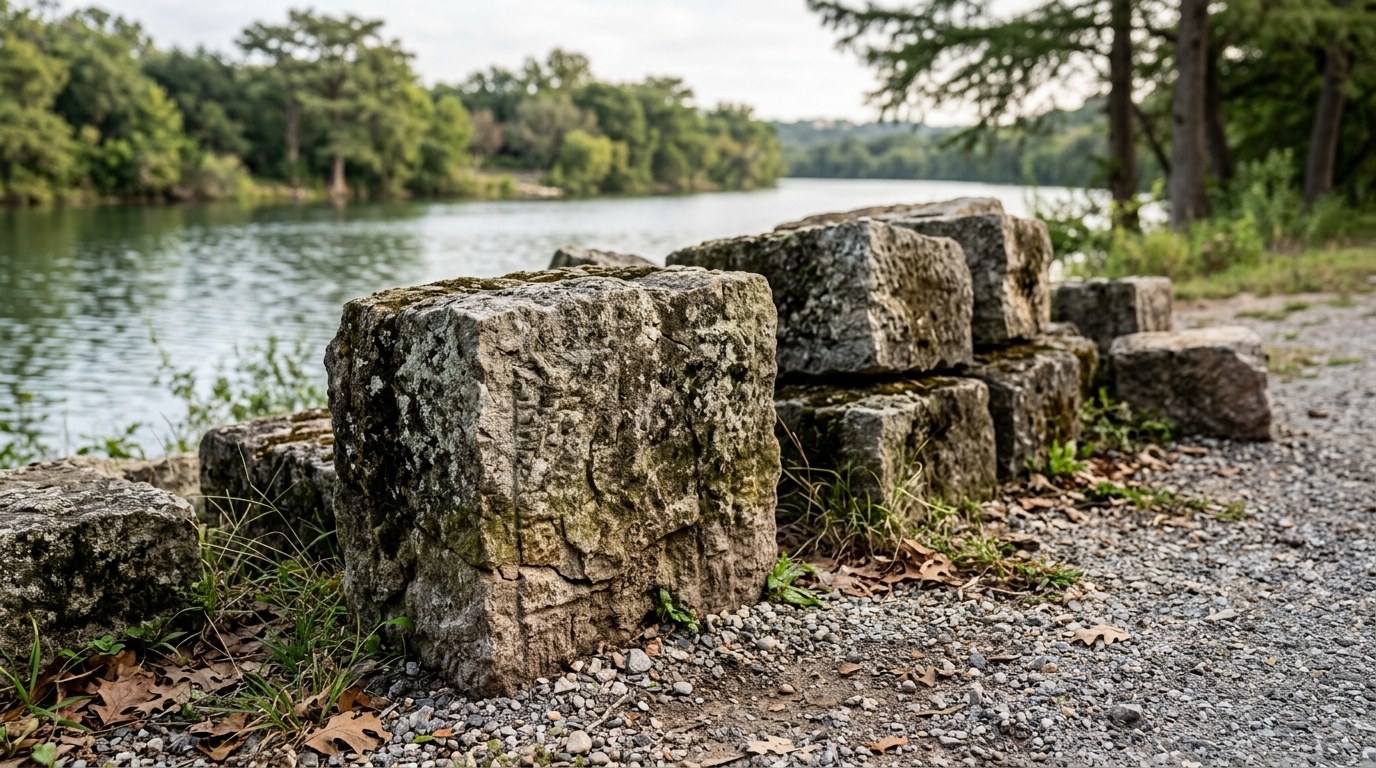
Look for the granite blocks lining the edge of Red Bud Isle's parking lot and along the shoreline nearest the dam — those are original 1893 stones, not decorative landscaping. There's no plaque explaining what they are, so most visitors walk right past them.
What's There Today
Red Bud Isle
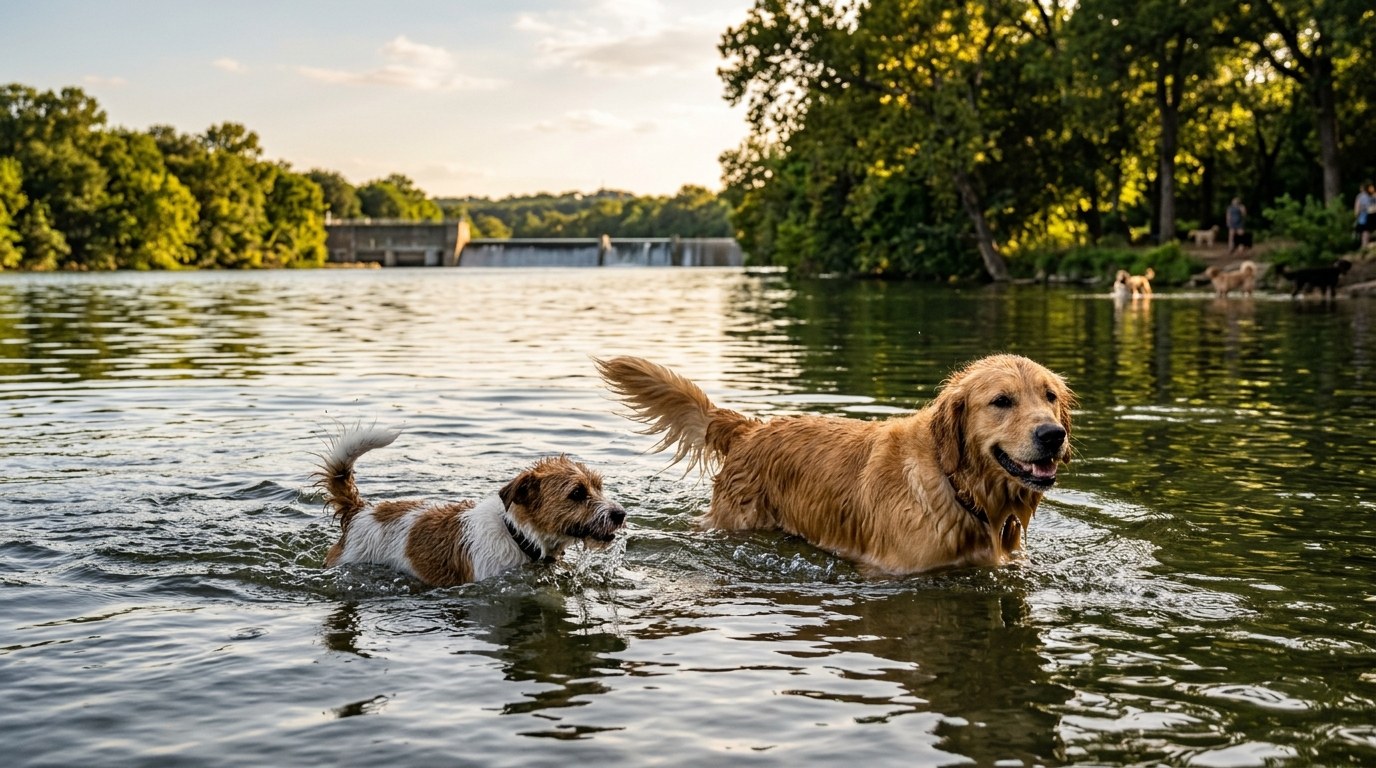
FreeRed Bud Isle is now a 13-acre off-leash dog park on Lake Austin, rated 4.6 stars from more than 1,800 Google reviews as of today, with a walking loop, a rocky swim entrance for dogs, and views of Tom Miller Dam just upstream. With today's forecast pushing 99°F in Austin, it's exactly the kind of shaded, water-adjacent spot that gets busy fast — go early. It's one of the more visited off-leash parks in the city, and the reviews are consistent about the two things that matter most if you're planning a visit:
- Genuinely scenic — a shaded loop trail along the water with the dam in view Dogs can swim off-leash right in Lake Austin Free
- open daily 7 AM to 10 PM
- no reservation needed
- Only about 16 parking spots serve the whole park — arrive early or expect to wait in a line of cars Car break-ins are a recurring complaint in recent reviews; don't leave valuables visible Water quality isn't guaranteed swim-safe every day — blue-green algae has caused dog illnesses and deaths at other Austin waterways in past years
- so check the city's current water-quality postings before letting a dog swim
- especially in late summer
"This is one of my favorite off leash dog parks. My dog loves running freely and jumping into the water. She's had plenty of positive interactions with other dogs. It's not a long hike but you can do a couple rounds if you'd like a longer walk. The only downfall is parking.
That parking bottleneck shows up in review after review, and it's the single biggest practical thing to know before you go: 16 spots is genuinely all there is, Redbud Trail itself is a narrow residential street where the city tickets aggressively, and on nice-weather weekends a line of cars waiting for a spot to open up is normal, not an exception.
What Locals Should Know
- Address: 3401 Redbud Trail, Austin, TX 78746, off Lake Austin Boulevard near Tarrytown.
- Cost: Free. No entry fee, no reservation.
- Hours: 7 AM–10 PM daily, per current Google listing data.
- Parking: About 16 spots on-site; arrive before 9 AM on weekends or expect to circle and wait.
- What's actually there from 1900: Granite blocks along the shoreline and parking lot edge — the original dam's remains, not a monument built to look old.
- Nearby: Tom Miller Dam (the 1940 rebuild), and about ten minutes further west, the free peacock garden at Mayfield Park — another Old West Austin stop most people drive past.
You don't need to know any of this history to enjoy Red Bud Isle — plenty of Austinites have walked their dogs there for years without ever hearing about the dam. But the next time you're waiting in that parking line, look down at the rocks under your feet. They're not landscaping. They're what's left of the most consequential five minutes in Austin's early history.
FAQ
Was Red Bud Isle formed by a real disaster, or is that just a local legend? It's documented history, not legend. City of Austin planning records for the site state plainly that "Red Bud Isle was formed in 1900 by the catastrophic collapse of the Great Granite Dam," and the event is separately corroborated by University of Texas historians, Austin History Center archives, and contemporary newspaper accounts from April 1900.
How many people actually died? Two different, both-accurate numbers get cited depending on what's being counted: eight people drowned instantly when the powerhouse flooded in the initial collapse, and the broader flood that followed toward downtown Austin killed at least 50 people and destroyed close to 100 homes citywide, according to Austin History Center records.
Can you still see the actual dam ruins today? Yes. Granite blocks from the 1893 dam are visible along Red Bud Isle's shoreline and parking lot edge, and additional original stonework was incorporated directly into Tom Miller Dam when it was rebuilt in 1940 — some of what you'd be looking at at the dam itself is 130-plus-year-old granite.
Is it safe to let my dog swim there? Most days, yes — it's one of Austin's most popular off-leash swim spots. But blue-green algae blooms have caused documented dog illnesses and deaths in other Austin waterways in recent years, especially in late summer heat, so check current city water-quality advisories before swimming a dog anywhere on Lake Austin or Lady Bird Lake, not just at Red Bud Isle.
What's the parking situation really like? Tight. Multiple recent Google reviews independently describe roughly 16 total spaces and waits of 30–45 minutes on busy weekends. Go early on a weekday morning if you want to skip the line.
Correction policy: if new detail on the site's history or current conditions comes to light, we'll update this piece and note the change here with the date.
Related Austin Data
Share this article