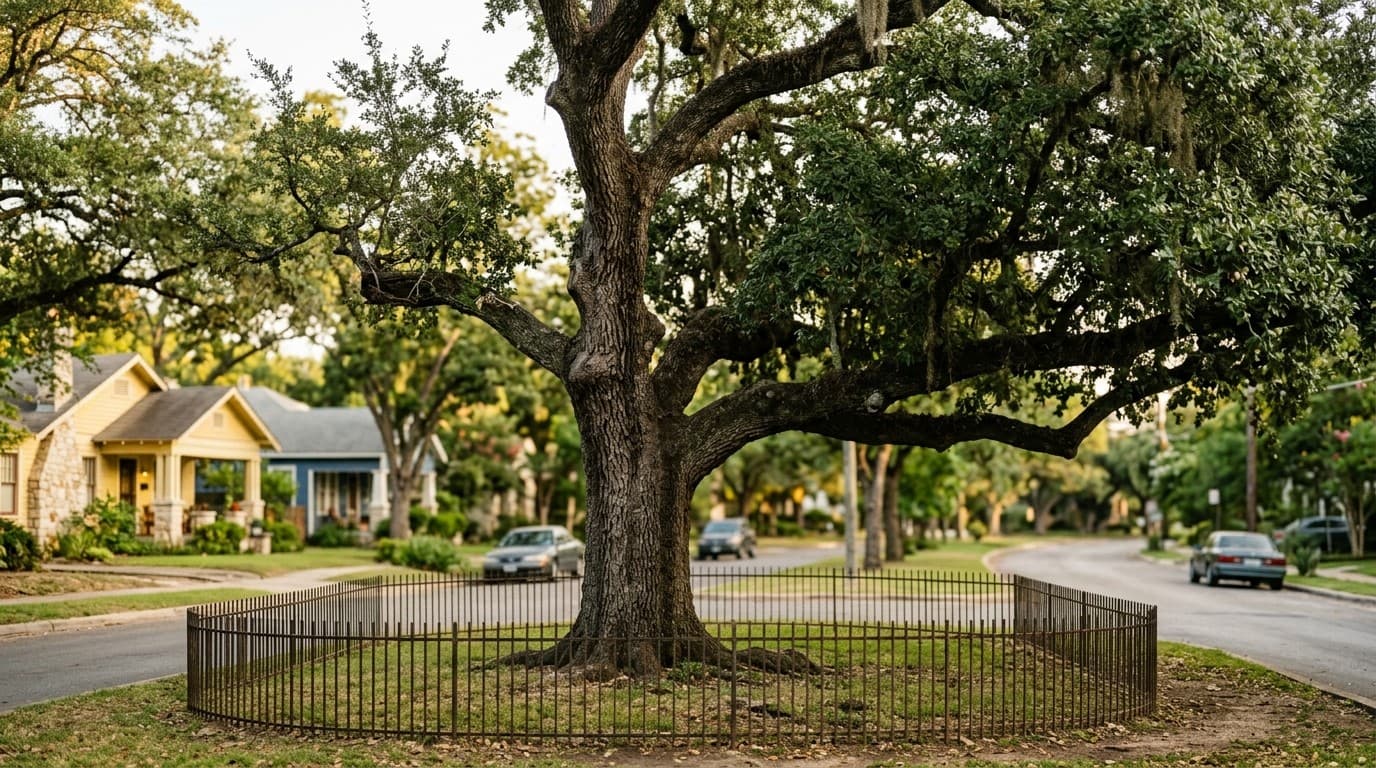
Most people who cut down Baylor Street between 5th and 6th never notice the tree behind the low iron fence. It's just shade in a pocket park barely a third of an acre. According to ATX Things analysis of the Austin History Center's own archives and the Texas State Historical Association, that tree is roughly 500 years old, the last survivor of a grove sacred to the Comanche and Tonkawa, and in 1989 a man tried to kill it with an herbicide because he believed it would win back a woman's love. It's a stranger, older story than the one behind Austin's moonlight towers a few miles away.
It didn't work on the woman. It nearly worked on the tree.
What is Treaty Oak, and why does it have that name?
The tree's official City of Austin name is Caldwell Treaty Oak, and it sits in Caldwell Treaty Oak Park, a 0.3-acre pocket park at 507 Baylor St., Austin, TX 78703, in the Clarksville/West Line Historic District just west of downtown. Foresters estimate its age at around 500 years, and before the events of 1989 its canopy spread 127 feet — wide enough to shade the better part of a city block.
It's the last living member of what used to be 14 live oaks known as the Council Oaks. Local legend, repeated by the Austin History Center and the Texas State Historical Association alike, holds that Stephen F. Austin met with Comanche and Tonkawa representatives beneath these trees to negotiate an early boundary agreement between settlers and Native nations — hence "Treaty Oak." Both institutions are careful to note the story is oral tradition, not a document anyone has produced. What's better documented: the land belonged to Republic of Texas treasurer James H. Raymond in the 1840s (the tree was originally called "Raymond's Oak"), passed to the Caldwell family in 1882, and by the 1920s Mrs. W.H. Caldwell couldn't sell the lots for development because the tree's own canopy covered them. Preservation groups pushed the city to buy the land instead of letting it fall to a developer's saw. Austin City Council closed the deal in 1937, for $1,000.
Caldwell Treaty Oak Park
FreeIn 1927, the American Forestry Association inducted Treaty Oak into its Hall of Fame for Trees and called it the most perfect specimen of a North American tree on record. For sixty-two years after that, its biggest threat was old age.
What happened to Treaty Oak in 1989?
In the summer of 1989, arborists noticed the tree was dying from the inside out — leaves browning, bark splitting, no obvious cause. Soil tests found the answer: someone had poured Velpar, a hardwood-killing herbicide, in a ring around the trunk. Lab analysis later showed the dose was enough to kill 100 mature trees, not one.
The city assembled a task force of the country's top arborists. They packed the root zone with activated charcoal, replaced contaminated soil by hand, rigged a misting system to keep the exposed roots from drying out, and — on one now-famous night — pumped sugar water directly into the tree's vascular system on a specialist's hunch that it needed calories to fight the poison. Texas industrialist Ross Perot reportedly told the crew to spend whatever it took and send him the bill. Schoolchildren across the country mailed handmade get-well cards, which the city taped to the park fence by the hundreds. DuPont, which manufactures Velpar, put up a $10,000 reward for the poisoner's capture.
""In those conversations he says, 'I was in Texas prisons for something, and I resented it, and this was a way for me to pay Texas back,' by poisoning this tree. That's why I think he did it." — Bob Perkins, the judge who presided over the poisoner's trial, recalling the recorded confession, in a 2022 interview with Austin's NPR station KUT
The reward worked. A woman named Cindy Blanco told police she knew who'd done it and agreed to wear a wire. On tape, a man named Paul Stedman Cullen admitted to poisoning the tree, reportedly telling her he'd done it as part of an occult ritual meant to win back a woman he was obsessed with — the tree, in his account, had to die for the spell to take. At trial, his lawyers argued he'd only said that to impress Blanco and that traces of Velpar in his car meant nothing because he worked with farm chemicals. The jury didn't buy it. Cullen was convicted of felony criminal mischief and sentenced to nine years in prison — the judge quoted above suspects revenge against the state, not romance, was the real motive, whatever Cullen told Blanco on tape.
Sources differ slightly on exactly how much of the tree survived. The Austin History Center puts it at roughly a quarter of the original tree; Wikipedia's sourcing (citing the National Park Service's historic-district filing) describes it as almost two-thirds of the canopy lost and more than half the crown eventually pruned away. Both figures point to the same reality: this is a visibly smaller, more asymmetric tree than the one in 1988 photos, not a fully restored specimen.
Is Treaty Oak still alive today?
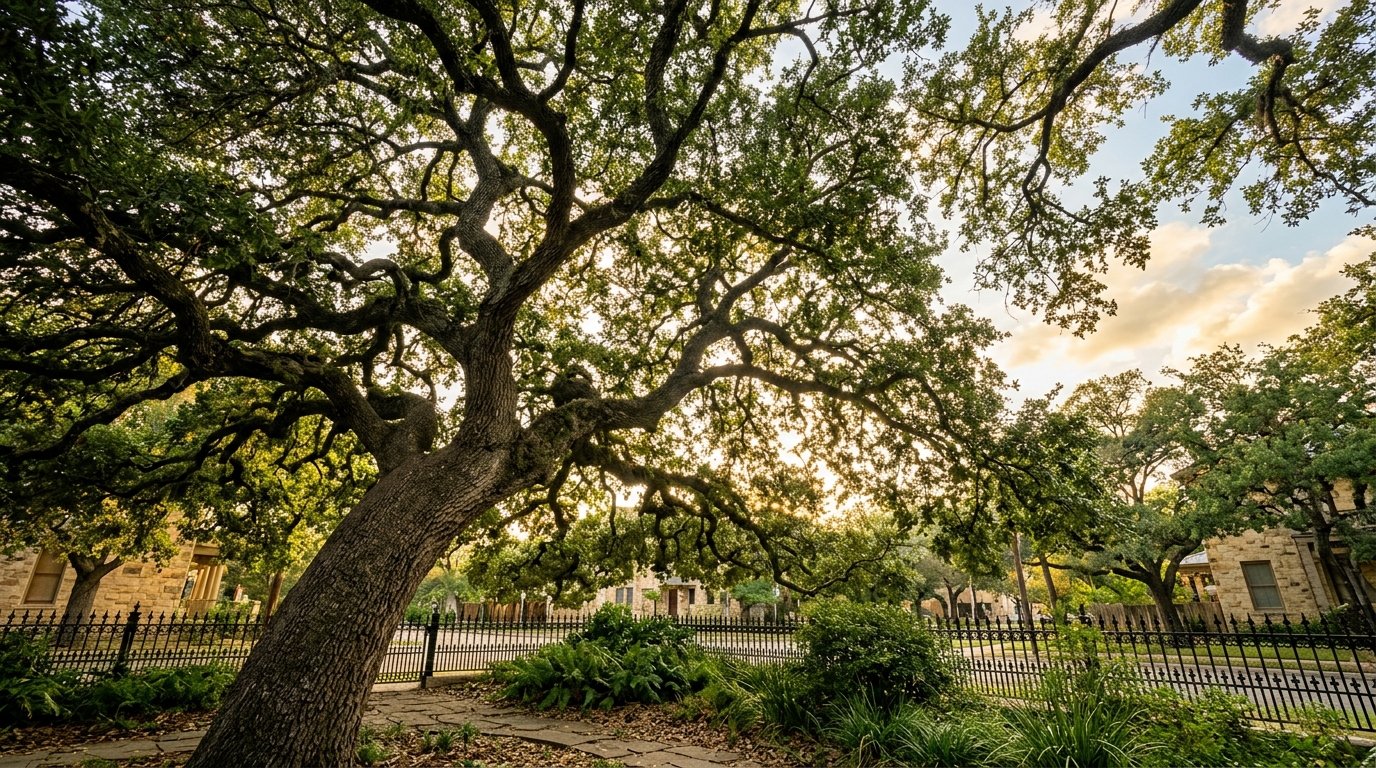
Yes. Nearly four decades on, the tree has filled back in enough that a first-time visitor with no reference photo might not immediately clock it as a survivor — until they notice the lopsided crown, heavier on one side than the other, where the arborists cut away the dead wood. It's still tended as a heritage tree by the city, and ISA-certified arborists periodically trim it as one of Austin's protected landmark trees.
There's no parking lot — Treaty Oak Park is a residential-street pocket park, so plan on street parking along Baylor, 5th, or 6th and a short walk in. It's a five-minute stop, not a destination hike, which makes it an easy add-on if you're already near West 6th or Clarksville.
With today's high climbing to 102°F and the heat dome holding through the weekend, this is exactly the kind of stop that works when a full outdoor outing doesn't: shaded, free, and over before you've worked up a real sweat. It won't replace a trip to Austin's Free Cooling Centers on the worst afternoons, but it's a genuine five-minute detour, not a commitment. If you want to make a longer loop of it, Mayfield Park's free peacock garden is about ten minutes further west and works the same way — free, shaded, and easy to miss if you don't already know it's there.
What locals should know
- Address: 507 Baylor St, Austin, TX 78703 — between W. 5th and W. 6th, in Clarksville, about a mile west of the Capitol.
- Cost: Free, no reservation, no ticket.
- Hours: Standard Austin park hours, 5 AM–10 PM daily, per the Parks and Recreation Department's citywide policy.
- Parking: Street only — there's no dedicated lot.
- What you'll see: A live oak with a visibly asymmetric canopy, a small plaque, and a fence line that once held thousands of children's get-well cards.
- What you won't see: Any marker retelling the poisoning in detail on-site — most of that history lives in archives and news coverage, not signage in the park itself.
Treaty Oak isn't a big outing — it's a five-minute stop with a story most Austinites have never heard, even though a lot of them have driven past it. If you're the kind of person who wants to actually know the place you live in, it's worth the detour once.
FAQ
Is Treaty Oak really 500 years old? Foresters' estimates put it around 500 years, based on growth-ring analysis of similar live oaks in the region (the tree itself has never been cored or cut for direct ring counting, since that would harm a living heritage tree). It predates Austin's founding as a city by roughly three centuries.
Did Stephen F. Austin really sign a treaty under this tree? That's the local legend, and it's where the name comes from — but both the Austin History Center and the Texas State Historical Association describe it as oral tradition without a surviving document to confirm it, not settled fact.
Who poisoned Treaty Oak, and why? Paul Stedman Cullen was convicted in 1990 of felony criminal mischief for pouring the herbicide Velpar around the tree's base in 1989. He told an informant he did it as part of an occult ritual to win back a woman; the trial judge later said he believed the real motive was resentment toward the state of Texas over a prior prison sentence.
Can you still visit Treaty Oak? Yes — it's a public city park, free and open during standard Austin park hours, at 507 Baylor St. There's no admission and no scheduled tour; you just walk up.
How much of the original tree is left? Sources vary — the Austin History Center estimates about a quarter of the original tree survived; other citations put canopy loss at closer to two-thirds. Either way, arborists expected the tree to die outright, and it didn't.
Correction policy: if new detail on the tree's current condition or the case's court record comes to light, we'll update this piece and note the change here with the date.
Related Austin Data
Share this article