Austin voters will decide this November whether the city borrows $295 million for parks, pools and libraries — and the list of what that money actually touches is already public. According to ATX Things analysis of the city's own bond documents, the package breaks into a $260 million parks proposition and a $35 million library proposition, and it would add roughly $40 a year to the property tax bill on a median-valued Austin home.
City Council placed the measure on the November 3 ballot last week after two years of on-and-off debate about whether Austin could afford another bond while money from the 2018 bond program is still being spent. The vote to finalize the package was 8-3 on Tuesday, August 4; the vote to formally call the election was unanimous two days later.
What is actually on the November ballot?
Two bond propositions, plus eight separate charter amendments. Proposition A is $260 million for parks — buildings, trails, land acquisition and four public pools. Proposition B is $35 million for libraries — a major renovation at one branch and a brand-new building at another. None of it is guaranteed; both propositions need a simple majority of Austin voters on November 3 to pass.
This is a genuine either-or vote, not a formality. Mayor Kirk Watson and two council members opposed even putting it on the ballot, arguing the city should wait until 2028, when the 2018 bond program is closer to fully spent. Voters, not just council, decide whether that argument wins.
Which parks and pools actually get money?
The $260 million splits four ways. About $65.5 million goes to park buildings and facilities, including work at the Gus Garcia Recreation Center, Doris Miller Auditorium and Mayfield Park. Roughly $65 million funds parkland improvements at a long list of neighborhood parks — Jamestown, Bolm District, Walter E. Long Metro Park, Lantana, Wooldridge Square, Onion Creek Metro Park, Guitar Land, Grand Meadow and Commons Ford among them. Another $29.5 million goes to infrastructure work at places like Zilker Metro Park, Mount Bonnell, Circle C Metro Park, Evergreen Cemetery and the Onion Creek All Abilities Playground, plus citywide electric infrastructure upgrades. The last $35 million is set aside for new "infill" parks in park-deficient neighborhoods, greenway trail connections and land for a new southeast recreation center.
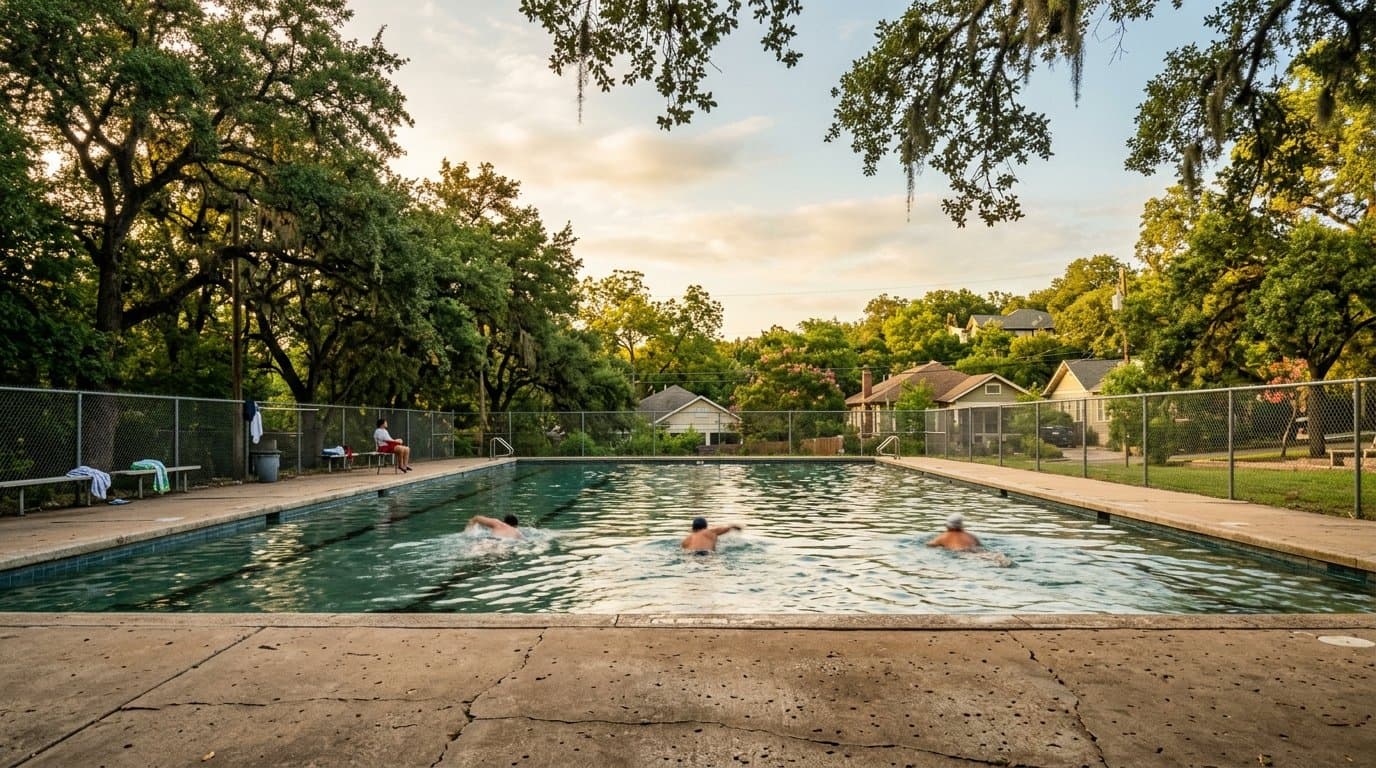
Four pools get direct renovation money out of a combined $65 million: Garrison Municipal Pool, Big Stacy Neighborhood Pool, Walnut Creek Municipal Pool and Civitan Neighborhood Pool. Three of those are neighborhood pools most non-locals have never heard of — which is exactly the point of a parks bond built around maintenance, not a splashy new attraction.
Big Stacy Neighborhood Pool
FreeBig Stacy is a good place to see what the bond is actually paying for. It's a free, spring-fed neighborhood pool in Travis Heights, built into a natural spring rather than a poured concrete basin, and it's one of the small handful of city pools that stays open (and stays cold) through the worst of an Austin August. It closes Mondays for maintenance and runs shorter weekend hours.
4.5★ from 331 Google reviews (as of today). One frequent visitor put it plainly:
"The water is spring fed, so it stays refreshingly cool even during those brutally hot Texas summers... It's not overly commercial or packed with tourists — just locals, families, and people looking to unwind.
Big Stacy is closed Mondays for cleaning. If you're heading over after work, the pool cuts off entry well before its posted closing time on busy summer evenings — go earlier in the day if you can.
What does the library money pay for?
The $35 million library proposition funds two things: a $20 million renovation and expansion of the Hampton Branch at Oak Hill, and $15 million for a brand-new library at Colony Park, in Northeast Austin's Eastern Crescent. That second one carries real weight locally — Colony Park Neighborhood Association's Barbara Scott told council the project "represents more than a new building, it is an investment in the Colony Park community... a step toward addressing years of disinvestment." Colony Park has never had its own library branch.
What would it cost me?
For the owner of a median-valued Austin home — the city put that figure at about $485,000 — the combined bond would add roughly $40 a year in property taxes if both propositions pass, moving the average city tax bill on that home from about $2,071 to $2,111. The city's own estimate assumes the actual hit would be smaller in the early years, since bond money gets spent (and taxed for) gradually rather than all at once.
That's about $3.33 a month, citywide, if both propositions pass — not a per-neighborhood figure, and not guaranteed until voters approve it.
Why did three council members vote no?
Money. Council Member Mike Siegel, who supported the package, argued it was "laser-focused on some of the greatest areas of need for our capital program" and small enough not to burden taxpayers. City financial staff had recommended in the spring that council wait until 2028, when the 2018 parks bond would be considered substantially spent — the standard the city uses to judge whether it's ready to ask voters for more debt. Mayor Watson sided with staff: "Good government is disciplined government... It doesn't change the rules because they're inconvenient." A council majority disagreed, arguing Parks and Recreation had already committed nearly all of its 2018 bond money and couldn't wait two more years for pool and trail repairs.
- Four aging city pools get dedicated renovation money
- not just deferred maintenance Colony Park gets its first-ever library branch after years of advocacy Roughly $40/year cost is smaller than the 2018 bond by comparison
- Passes on top of a 2018 bond program that's still being spent down Mayor and city financial staff argued the timing works against fiscal discipline Neither proposition is guaranteed — both need separate majority votes
What else is on the same ballot?
Eight charter amendments, most of them cleanup language, but two are substantive: one would require an efficiency audit of every city department every five years, and another would move citizen-petition elections to only happen during November elections in even-numbered years — a change intended to catch higher turnout, though critics argue it could delay ballot initiatives by up to two years.
What locals should know
- Two separate votes, not one bond. You can vote for the parks money and against the library money, or vice versa — they're separate propositions.
- Voter registration deadline: October 5, 2026.
- Early voting runs October 19–30, 2026 at any Travis County polling location.
- Mail ballot applications are due October 23, 2026.
- Election Day is Tuesday, November 3, 2026.
- Nearly all of the parks money goes to existing, named parks — not new land purchases — so most of the impact shows up as repairs and upgrades at places already open today.
None of this is final. Both propositions require voter approval on November 3 — city council's vote only decided what goes on the ballot, not whether it passes.
What else is building near Big Stacy right now
📋Daily permit data from City of Austin
This is the first parks bond Austin voters have seen since 2018, and it's narrower than that one — pool and trail repairs over splashy new builds, plus one genuinely overdue library for a neighborhood that's never had one. Whether it passes comes down to whether voters trust the "can't wait" argument over the "not yet" one — both sides made a real case, and only the ballot settles it.
We're watching how the Colony Park library debate plays out as the campaign season heats up — follow @austintexasthings for updates as early voting approaches.
FAQ
When do Austin voters decide on the parks and libraries bond? Election Day is Tuesday, November 3, 2026. Early voting runs October 19–30, and the voter registration deadline is October 5.
How much would the bond cost me? About $40 more a year in property taxes for the owner of a median-valued Austin home (roughly $485,000), if both propositions pass — moving the average annual city tax bill from about $2,071 to $2,111.
What pools would get renovated? Garrison Municipal Pool, Big Stacy Neighborhood Pool, Walnut Creek Municipal Pool and Civitan Neighborhood Pool would split $65 million in renovation funding.
Is this the same as the 2018 parks bond? No — this is a new, smaller bond. The 2018 bond is still being spent down, which is exactly what the mayor and two council members cited in voting against calling this election.
Where would the new library go? Colony Park, in Northeast Austin, would get its first library branch, funded at $15 million. The Hampton Branch at Oak Hill would get a separate $20 million renovation and expansion.
Related Austin Data
More Austin Guides
Share this article