Listen to this story 12:34
Jump to a section
Read aloud by an AI voice (ElevenLabs) from the story on this page, which is the full transcript. Tables and maps are summarized in the audio.
Quick answer: A home listing tells you about one house. Austin's public records tell you what's been filed around it. According to ATX Things analysis of two neighborhood guides on our sister site, Austin Local Team, one Crestview point had 1,023 construction permits within half a mile in two years, while one North Burnet point had 216 permits but 22 state project registrations (both read Nov. 17, 2026). Here's how to read each record layer before you tour, rent or buy in Austin, Texas.
Those two numbers aren't a verdict on either place. They're a lesson in what kind of paper trail sits behind each one. One area is changing lot by lot. The other is changing building by building, and much of what's filed is commercial and state work. You'd want to know which kind you're moving into.
Disclosure: Austin Local Team is a sister site of Austin Texas Things. Its listing and neighborhood pages are built on the same Zabalist public-records database this desk reports from. Austin Local Team is brokered by All City Real Estate, ltd. Co. (TREC #9003633). The Information About Brokerage Services and Consumer Protection Notice are on its about page.
What is Austin Local Team, and what does it show?
Austin Local Team is a home search for homes for sale and for rent across Travis, Williamson, Hays, Bastrop and Caldwell counties, using listings from Unlock MLS. Its tagline is "Find the home. See the records around it."
That second part is the point. Next to the listings, each neighborhood guide and listing page shows dated public records within 800 meters (about half a mile) of a map point: building permits, site plans, development projects, state TDLR project registrations, food inspections, traffic crashes and 311 requests. It adds FEMA flood zones, USGS geology and USDA soils, and ZIP-level code cases and liquor licenses. Each count names its source and time window. None of them are rolled into a rating.
How much is covered, as of Nov. 17, 2026:
| What | Count | Where we read it |
|---|---|---|
| Neighborhood guides (subdivisions and sections, five counties) | more than 4,200 | Local Team's neighborhood index |
| In-depth area and City planning-area guides | 132 | Local Team sitemap |
| ZIP code research pages | 47 | Local Team ZIP page list |
The neighborhood footprints are approximate. They're built from MLS subdivision names and recorded plats, not official boundaries. No account is needed to search.
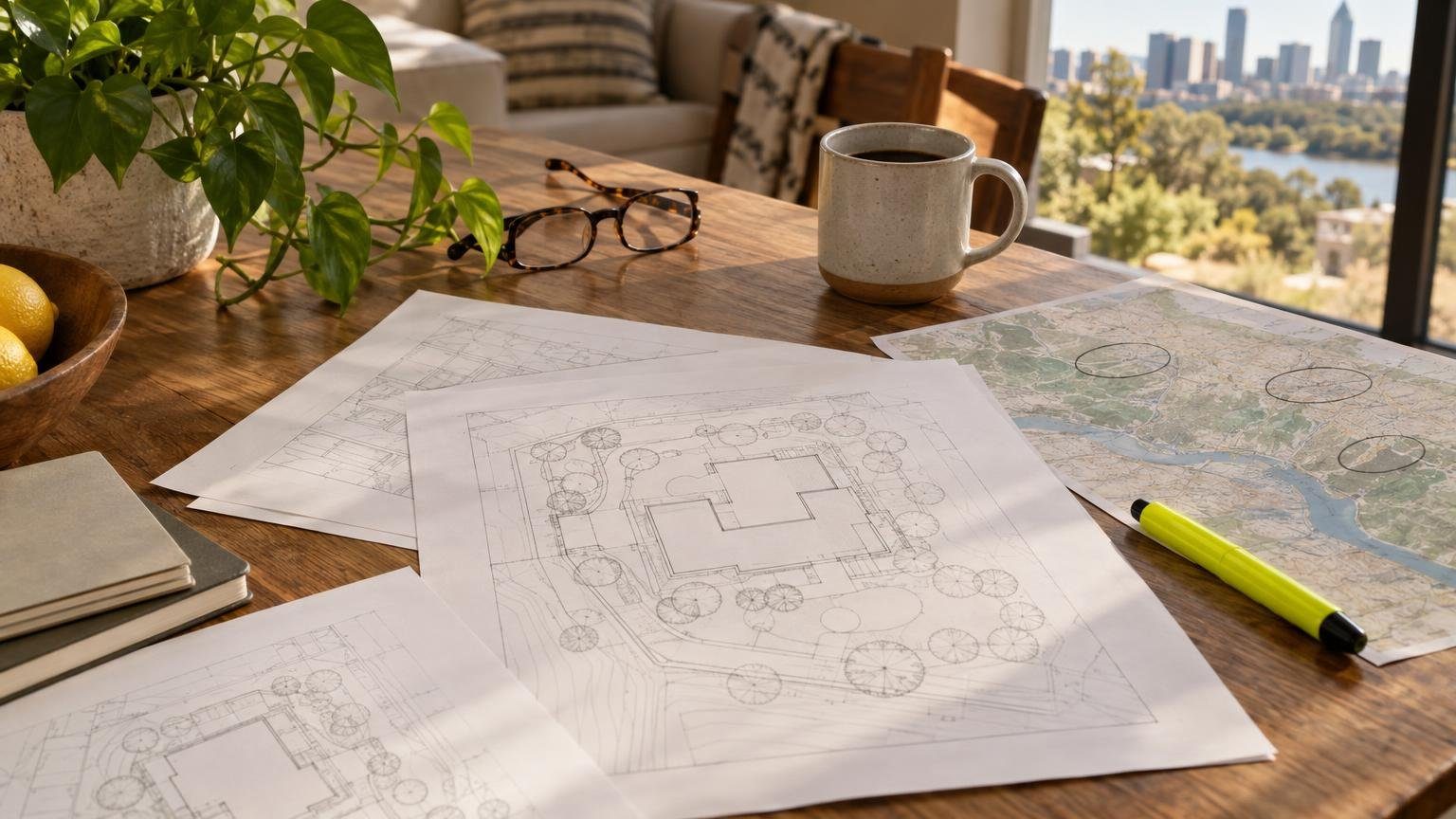 Generated illustration, not a real home or listing.
Crestview and North Burnet: two half-miles, two kinds of records
We picked two in-depth guides about three miles apart in North Central Austin. Every figure below is from the guide pages as rolled up Nov. 17, 2026. They're counts of public filings, not conclusions about a home, a block or the people who live there.
| Record layer (window) | Crestview | North Burnet |
|---|---|---|
| Construction permits within 800 m (2 years) | 1,023, incl. 68 new residential buildings | 216, incl. 145 trade permits |
| Demolitions and teardowns inside the area (24 months) | 98 | 9 |
| New single-family / ADU / multifamily permits inside the area (24 months) | 14 / 12 / 2 | 0 / 0 / 9 |
| Site plans and zoning cases inside the area (24 months) | 5 and 1 | 22 and 7 |
| TDLR state project registrations within 800 m (12 months) | 0 | 22 |
| Traffic crashes within 800 m (3 years) | 40 | 145 |
| 311 requests within 800 m (12 months) | 1,118 (top type: garbage, 245) | 231 (top type: traffic signal maintenance, 63) |
| Homes in FEMA's 1% annual-chance floodplain | 0% | 0.8% |
| Active rentals / homes for sale in the feed | 13 / 22 | 18 / 4 |
Read across the rows and two patterns show. Crestview's permits are mostly houses: teardowns, new homes and accessory dwelling units. North Burnet's stand out for larger filings: state registrations, site plans and zoning cases. Neither is better. They just tell you different things to check.
1. Building permits: what's being torn down or built near you?
What it tells you: a City of Austin permit to build, demolish, remodel or do trade work.
Why it matters before you sign: 98 teardowns in two years inside one area means demolition crews, dumpsters and new construction on nearby lots for a while. That's not good or bad. It's months of trucks if you work from home. If you're buying, a permit on the house itself shows what work was done with a permit.
Look up the exact address on the City's Austin Build + Connect permit search and compare it to what the seller or landlord says was updated.
2. Site plans and zoning cases: what's been proposed?
What it tells you: a site plan is the City's application for anything beyond a single house. A zoning case asks to change what land can be used for. Both come before construction.
Why it matters: they're your earliest notice. North Burnet's guide shows 22 site plans and 7 zoning cases inside the area in two years. A site plan is a proposal, not an approval or a finished building, so read its status.
Our own count for context: Zabalist's site-plan table holds 15 applications filed in ZIP 78758 and 12 in ZIP 78757 between Nov. 17, 2025 and Nov. 17, 2026 (City of Austin site plans, database sync Nov. 15, 2026).
3. TDLR registrations: the state filings that show up early
What it tells you: Texas requires a project registration with the Texas Department of Licensing and Regulation for commercial and public construction above a cost threshold, for accessibility review. A filing means a project was submitted, not that it was built.
Why it matters: a registration often lists the owner, scope and estimated cost months before work starts. Near the North Burnet point, our TDLR table includes a $46.5 million HVAC and life-safety renovation at the University of Texas Microelectronics Research Center (registered July 28, 2026), a $1.4 million roof replacement at a Texas DPS headquarters building (Nov. 11) and several office-suite build-outs at One Uptown on Burnet Road (Texas TABS records, synced Nov. 15, 2026). Across ZIP 78758 we count 93 registrations in the past 12 months; ZIP 78757 has 22.
Notice what that means for Crestview: zero registrations within 800 meters of its map point, but 22 across its ZIP. The radius and the ZIP are different questions. Search the state's records yourself on TDLR's TABS search.
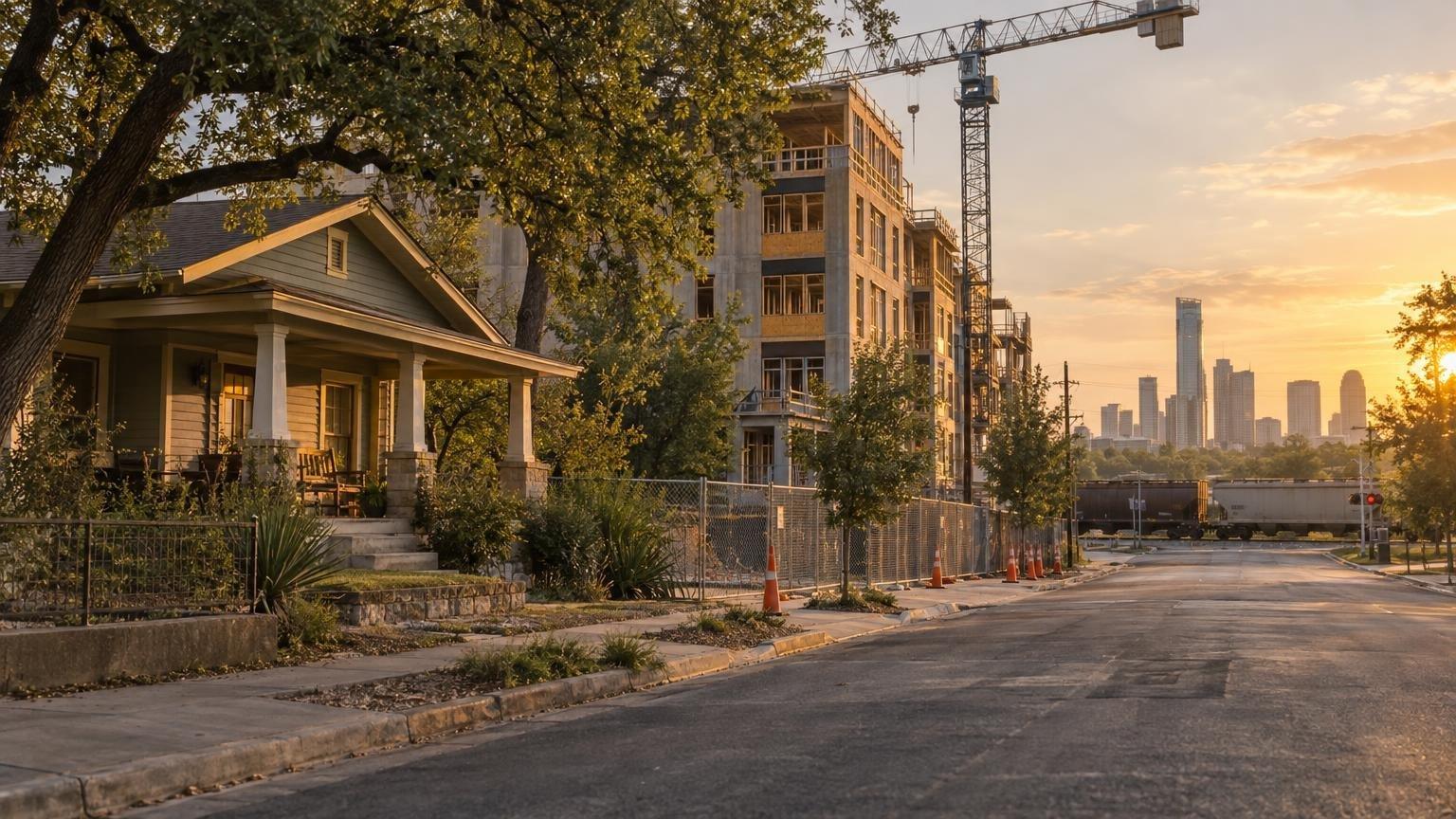
 Generated illustration of a generic Austin street, not a real home or listing.
4. Flood maps: what renters are owed, too
What it tells you: FEMA's flood map is the one lenders and insurers use. The City of Austin also models its own floodplain with newer rainfall data. OpenFEMA reports flood-insurance claims by ZIP.
Why it matters: North Burnet's guide shows 0.8% of homes in FEMA's 1% annual-chance zone and 1.8% in the City's modeled floodplain, with 22 National Flood Insurance Program claims paid in ZIP 78758 in the past 10 years. Crestview's shows 0% on both maps and 14 claims in ZIP 78757.
Renting? Texas Property Code § 92.0135 requires most landlords to tell you in writing whether they know the unit is in a 100-year floodplain, and whether flooding damaged it in the past five years. The required notice also says most renter's insurance policies don't cover flood. Check the exact address on FEMA's Flood Map Service Center.
For a deeper walk-through, see our guide on how to read a FEMA flood zone.
5. Soils and the aquifer: what's under the slab?
What it tells you: USDA soil surveys map shrink-swell clay, which moves foundations. TCEQ maps the Edwards Aquifer recharge zone, where extra state rules apply to building.
Why it matters: North Burnet's guide notes 2.7% of homes sit over the recharge zone. Both guides say a soil map is a starting point and a foundation inspection is the check for one home.
6. Crashes, 311 and code cases: what's been reported
What it tells you: City crash reports, 311 service requests and code-compliance cases.
Why it matters: they show what people reported, nothing more. A 311 request records that something was reported, not that it was verified. An opened code case isn't a confirmed violation. Code cases count by ZIP: 762 in ZIP 78757 and 2,136 in ZIP 78758 in the past 12 months. Use them to form questions for a landlord or seller, not answers.
For renters, Local Team's guides also draw on the City's Repeat Offender registry of rental properties. Local Team explained how to read it in its Nov. 7 report.
7. What's coming: transit, roads and internet
The guides also list what's planned or available. Crestview's shows the planned Crestview light rail station (a priority extension) inside the area and fiber reported at 95% of locations. North Burnet's shows six active TxDOT projects crossing the area and fiber at 55.9% of locations. Provider filings with the FCC aren't a promise of service at an address, so check with the provider. Our transit page and internet data carry the citywide view.
What locals should know
- Read the window. "Past 2 years," "past 12 months" and "inside the area" are different numbers. Don't add them.
- Radius isn't ZIP. Crestview's zero TDLR filings within 800 m and 22 across its ZIP are both true.
- A map point isn't your house. Click through to the original filing and check its distance from the address you're touring.
- Outside Austin city limits, City of Austin layers don't apply, and Local Team leaves them out instead of showing zero. Our 800-meter check explains how that works in Kyle.
Things to do and what's changing around Crestview
Want a person to help?
The records are free to read on your own. If you'd rather talk it through with a licensed agent, Austin Local Team offers:
- Renting an apartment: plan an apartment search with a locator around your rent range, move date, pets and parking.
- Buying: search homes with the records in view, or request a home shortlist for Crestview, North Burnet or anywhere else.
- Selling or curious what your home is worth: request an agent-reviewed comparative market analysis (a CMA, not an appraisal or an automatic estimate), or plan your home sale.
- Still choosing an area: download the free moving-to-Austin neighborhood checklist.
Once more for clarity: Austin Local Team is our sister site, brokered by All City Real Estate, ltd. Co. (TREC #9003633). Nothing here is a recommendation of any home or area.
FAQ
What public records should I check before renting an apartment in Austin?
Ask for the landlord's written floodplain notice, then check the address on FEMA's flood map. Look at building permits and site plans nearby for construction, the City's Repeat Offender registry, and 311 and code-case counts. Those counts show what was reported, not conclusions, so use them to form questions for the landlord.
How many neighborhood guides does Austin Local Team have?
As of Nov. 17, 2026, its neighborhood index lists more than 4,200 neighborhood guides across Travis, Williamson, Hays, Bastrop and Caldwell counties, plus 132 in-depth area and City planning-area guides like Crestview and North Burnet. Footprints are approximate and built from MLS subdivision names and recorded plats.
What is a TDLR project registration?
It's a Texas state filing required for commercial and public construction above a cost threshold, so the project's design can be reviewed for accessibility. It usually lists the owner, scope, estimated cost and planned dates. A registration means a project was submitted, not that it was approved or built.
Is Austin Local Team affiliated with ATX Things?
Yes. Austin Local Team is a sister site of Austin Texas Things, built on the same Zabalist public-records database. It's brokered by All City Real Estate, ltd. Co. (TREC #9003633), and its brokerage notices are on its about page.
We'll keep reading these filings. Follow @austintexasthings for what's been filed near you next.
Related Austin Data
More Austin Guides
Share this article